
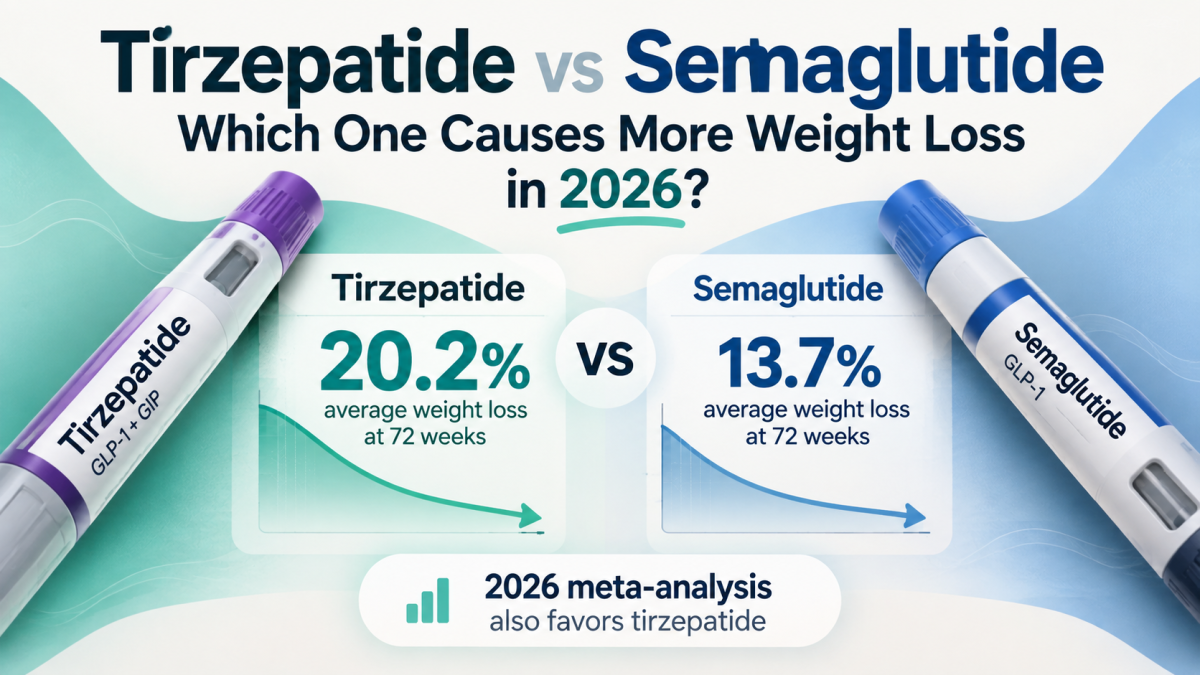
Tirzepatide vs Semaglutide: Which One Causes More Weight Loss in 2026?
Tirzepatide vs semaglutide in the head-to-head SURMOUNT-5 trial: weight loss, side effects, dosing and which may suit you, based on 2026 evidence.
Tirzepatide vs Semaglutide: Which One Causes More Weight Loss in 2026?
If weight loss is the only question, tirzepatide currently has the edge. In the strongest direct comparison so far, people taking tirzepatide lost an average of 20.2% of their starting weight over 72 weeks, compared with 13.7% with semaglutide. A 2026 meta-analysis combining 12 comparative studies reached the same overall conclusion: tirzepatide produced greater average weight loss.
That does not mean semaglutide suddenly became a weak medication. Losing around 14% of body weight is substantial. The interesting part is that when the two drugs finally went head-to-head at obesity-treatment doses, tirzepatide did not just win by a fraction — the average difference was large enough to matter.
Related: tirzepatide vs retatrutide, the tirzepatide dosage guide and before and after results.
Brand names explained: Mounjaro vs Zepbound. Prefer a pill? See is there a tirzepatide pill.
The Head-to-Head Result Changed the Conversation
For years, people compared tirzepatide and semaglutide using separate trials. That was useful, but never quite satisfying.
Different trials recruit different people, use different protocols, and happen at different times. Comparing a number from one study with a number from another can make two drugs look more directly comparable than they really are.
SURMOUNT-5 finally put the two medications into the same trial.
The study randomized 751 adults with obesity or overweight and at least one weight-related condition, but without type 2 diabetes. Participants received the maximum tolerated dose of either tirzepatide or semaglutide for 72 weeks.
The Number Everyone Cares About: 20.2% vs 13.7%
At 72 weeks, average weight loss was 20.2% with tirzepatide and 13.7% with semaglutide.
That is a difference of 6.5 percentage points of starting body weight.
Percentages can sound abstract, so imagine two people who both start at 250 pounds. A 20.2% reduction is about 50.5 pounds. A 13.7% reduction is about 34.3 pounds. That is roughly a 16-pound gap between the treatment averages.
The actual trial averages were almost exactly that: about 50 pounds lost with tirzepatide versus about 33 pounds with semaglutide.
What the Difference Looks Like at Different Starting Weights
- 1Starting at 180 lb — 20.2% is about 36 lb lost; 13.7% is about 25 lb
- 2Starting at 200 lb — 20.2% is about 40 lb lost; 13.7% is about 27 lb
- 3Starting at 250 lb — 20.2% is about 51 lb lost; 13.7% is about 34 lb
- 4Starting at 300 lb — 20.2% is about 61 lb lost; 13.7% is about 41 lb
These are illustrations based on trial averages, not predictions for an individual person. Some participants lost far more, some far less, and some stopped treatment before the study ended.
It Wasn't Just the Average
Averages can hide what is happening across the group, so researchers also looked at how many people crossed major weight-loss milestones.
Tirzepatide beat semaglutide at every major threshold measured in SURMOUNT-5: at least 10%, 15%, 20%, and 25% weight loss. In other words, the result was not being driven only by a handful of spectacular responders.
Waist circumference told the same story. Average reduction was 18.4 cm with tirzepatide versus 13.0 cm with semaglutide.
Then Came the 2026 Meta-Analysis
One head-to-head trial is powerful evidence. The next question is whether the same pattern survives when researchers combine the broader comparison literature.
A systematic review and meta-analysis published in 2026 included 12 randomized and observational studies that directly compared tirzepatide with semaglutide.
Across those studies, tirzepatide was associated with about 4.61 percentage points more body-weight reduction and about 4.76 kg more absolute weight loss than semaglutide on average.
People taking tirzepatide were also more likely to reach 5%, 10%, 15%, and 20% weight-loss milestones.
But the Meta-Analysis Comes With an Important Asterisk
The studies were highly heterogeneous.
That is researcher language for "these studies were not all telling exactly the same story under exactly the same conditions." They differed in populations, doses, follow-up, study design, and other details. Several were observational rather than randomized trials.
So the meta-analysis strengthens the overall pattern, but the cleanest single comparison remains the randomized SURMOUNT-5 trial.
A Much Bigger 2026 Analysis Points the Same Way
A separate 2026 BMJ network meta-analysis examined 262 randomized trials involving nearly 100,000 participants across multiple weight-loss medications.
At one year, tirzepatide was estimated to reduce body weight by about 14.9 percentage points more than lifestyle modification alone. Subcutaneous semaglutide was estimated at about 9.8 percentage points.
That analysis was not a simple direct tirzepatide-versus-semaglutide trial, so it should not replace SURMOUNT-5. But it independently lands in the same place: tirzepatide sits among the strongest currently available weight-loss medications.
Why Might Tirzepatide Cause More Weight Loss?
The obvious biological difference is that semaglutide mainly targets the GLP-1 receptor, while tirzepatide activates both GLP-1 and GIP receptors.
Both drugs can reduce appetite, affect fullness, slow digestion, and improve metabolic control. Tirzepatide adds a second incretin pathway, and the combined effect appears to produce greater average weight reduction.
That explanation is biologically appealing, but it is important not to oversimplify it into "two hormones are automatically twice as good as one." Human physiology is not that tidy, and the actual trial difference is much smaller than twofold.
Tirzepatide Wins on Weight Loss. Does That Mean It's Better?
Not automatically.
If your only scoreboard is percentage of body weight lost, the current evidence favors tirzepatide. Real treatment decisions have more columns than that.
- 1How much weight loss matters to you
- 2Which drug you tolerate better
- 3Your medical history
- 4Whether you have type 2 diabetes
- 5Other medications you take
- 6Insurance coverage and cost
- 7Availability
- 8Cardiovascular or kidney considerations
- 9How you respond to the first months of treatment
A medication that produces a higher average in a study is not necessarily the better medication for every individual person.
Don't Accidentally Compare Zepbound With Ozempic
This is one of the easiest ways to make the comparison confusing.
Semaglutide is an ingredient, not a single dose or brand. Wegovy is the semaglutide product used for chronic weight management. Ozempic also contains semaglutide but is used in the diabetes setting and has a different dosing context.
SURMOUNT-5 compared tirzepatide with obesity-dose semaglutide — effectively the Zepbound-versus-Wegovy question — not tirzepatide against a random lower dose of semaglutide.
What About Side Effects?
Both medications are famous for the same general family of complaints: nausea, diarrhea, constipation, vomiting, uncomfortable fullness, and other gastrointestinal problems.
In SURMOUNT-5, gastrointestinal adverse events were the most common side effects in both groups. Most were mild to moderate and occurred mainly while doses were being increased.
The comparison is not as simple as "the stronger drug causes more side effects." Tolerability varies enormously between individuals, which is why somebody can struggle on semaglutide and do well on tirzepatide — or the reverse.
What If You've Already Lost Weight on Semaglutide?
The existence of a medication with a higher average does not erase a good result.
If semaglutide is working, tolerable, accessible, and producing a meaningful result, a population average does not automatically create a reason to switch.
This is where comparison articles can become misleading. They make medications look like phones: model A has the bigger number, so throw away model B. Treatment does not work that way.
What If Semaglutide Has Stopped Moving the Scale?
This is where the comparison becomes more personally interesting.
Someone who has reached a long plateau, cannot reach a clinically useful result, or is discussing alternatives with their clinician may reasonably want to know that tirzepatide has produced greater average weight loss in direct research.
But switching medication is not something to improvise from a comparison chart. Dose transitions, side effects, contraindications, glucose-lowering medications, and other medical factors matter.
The Difference Is Real — but So Is Individual Variation
A 20.2% average does not mean every tirzepatide user loses 20%. A 13.7% average does not put a ceiling on semaglutide.
There were strong responders and weaker responders in both groups. A person taking semaglutide can lose more weight than another person taking tirzepatide.
The correct interpretation is about probabilities and averages: if you take comparable groups of people and treat them under similar conditions, the tirzepatide group is currently expected to lose more weight.
So Which One Causes More Weight Loss in 2026?
Tirzepatide.
That answer is now supported by a direct randomized head-to-head trial, multiple comparative studies, a 2026 direct-comparison meta-analysis, and a large 2026 network meta-analysis.
The strongest head-to-head number remains easy to remember: about 20% average weight loss with tirzepatide versus about 14% with semaglutide over 72 weeks in adults with obesity without diabetes.
If you are already taking semaglutide and are thinking about a change, our guide to switching from semaglutide to tirzepatide explains how doctors usually plan the transition.
Liraglutide is the older GLP-1 option many people compare as well. Our guide to liraglutide vs tirzepatide covers daily vs weekly dosing, trial results and the Saxenda changes.
The Bottom Line
Semaglutide changed obesity treatment. Tirzepatide appears to push average weight loss further.
In the cleanest direct trial, the difference was 20.2% versus 13.7%. In the 2026 meta-analysis, tirzepatide again came out ahead. That makes tirzepatide the stronger weight-loss option on average based on the evidence available today.
But "which drug loses more weight?" and "which drug should I take?" are two different questions. Research can answer the first one surprisingly well. The second one still depends on the person.
Frequently Asked Questions
On average, yes. In the SURMOUNT-5 head-to-head trial, average weight loss at 72 weeks was 20.2% with tirzepatide versus 13.7% with semaglutide. A 2026 meta-analysis of 12 comparative studies also found significantly greater weight loss with tirzepatide.
In SURMOUNT-5, the difference in average percentage weight loss was 6.5 percentage points after 72 weeks. The 2026 meta-analysis found a pooled difference of about 4.61 percentage points and about 4.76 kg of additional absolute weight loss favoring tirzepatide across included studies.
For average weight reduction, current direct evidence favors tirzepatide. SURMOUNT-5 compared maximum tolerated tirzepatide doses with maximum tolerated obesity-treatment doses of semaglutide and found greater weight and waist reduction with tirzepatide.
That question needs context. Ozempic contains semaglutide but is used primarily in type 2 diabetes, while the major obesity head-to-head trial compared tirzepatide with Wegovy-level semaglutide dosing. Comparing brand names without considering dose and indication can be misleading.
Both commonly cause gastrointestinal side effects such as nausea, diarrhea, constipation, and vomiting. In the head-to-head trial, gastrointestinal effects were common in both groups and were mostly mild to moderate. Individual tolerability varies.
Not based on the average alone. A switch may be worth discussing if your current treatment is not producing the desired result or is difficult to tolerate, but medical history, dose, side effects, other medications, cost, and access all matter.
Sources
This comparison is based on direct head-to-head research and systematic evidence reviews:
- 1Aronne LJ, et al. Tirzepatide as Compared with Semaglutide for the Treatment of Obesity. New England Journal of Medicine.
- 2Zufry H, Hariyanto TI. Head-to-head comparison of tirzepatide and semaglutide for weight loss: A systematic review and meta-analysis. Obesity Research & Clinical Practice. 2026.
- 3Comparative effects of drugs for adults with overweight or obesity: systematic review and network meta-analysis. BMJ. 2026.
Study averages describe groups rather than predicting an individual result. Dose, treatment duration, diabetes status, other medications, side effects, adherence, access, and individual biology can all affect weight loss. Written for general education; this page is not medical advice. Tirzepatide.review is independent and is not affiliated with, sponsored by, or endorsed by Eli Lilly, Novo Nordisk, or their products.

Nataliia Bondarchuk
Author
Comments (0)
Be the first to comment on this article.
More articles