
Tirzepatide vs Retatrutide: Is the New “Triple G” Drug Actually Better?
Tirzepatide vs retatrutide: trial weight loss, how the dual and triple agonists differ, side effects, and why retatrutide is not approved yet.
Tirzepatide vs Retatrutide: Is the New “Triple G” Drug Actually Better?
Retatrutide currently looks more powerful for average weight loss than tirzepatide — but there is an important catch. The two drugs have not yet been tested against each other in a large randomized head-to-head obesity trial.
That means the headline numbers are impressive, but they are not a clean winner-takes-all comparison. Retatrutide has produced average weight loss approaching 30% in Phase 3 research, while tirzepatide already has extensive clinical use, regulatory approval, direct comparative evidence against semaglutide, and a much larger real-world track record.
Related: what comes after tirzepatide, tirzepatide vs semaglutide and the tirzepatide dosage guide.
The Short Answer: Retatrutide Looks Stronger on Weight Loss
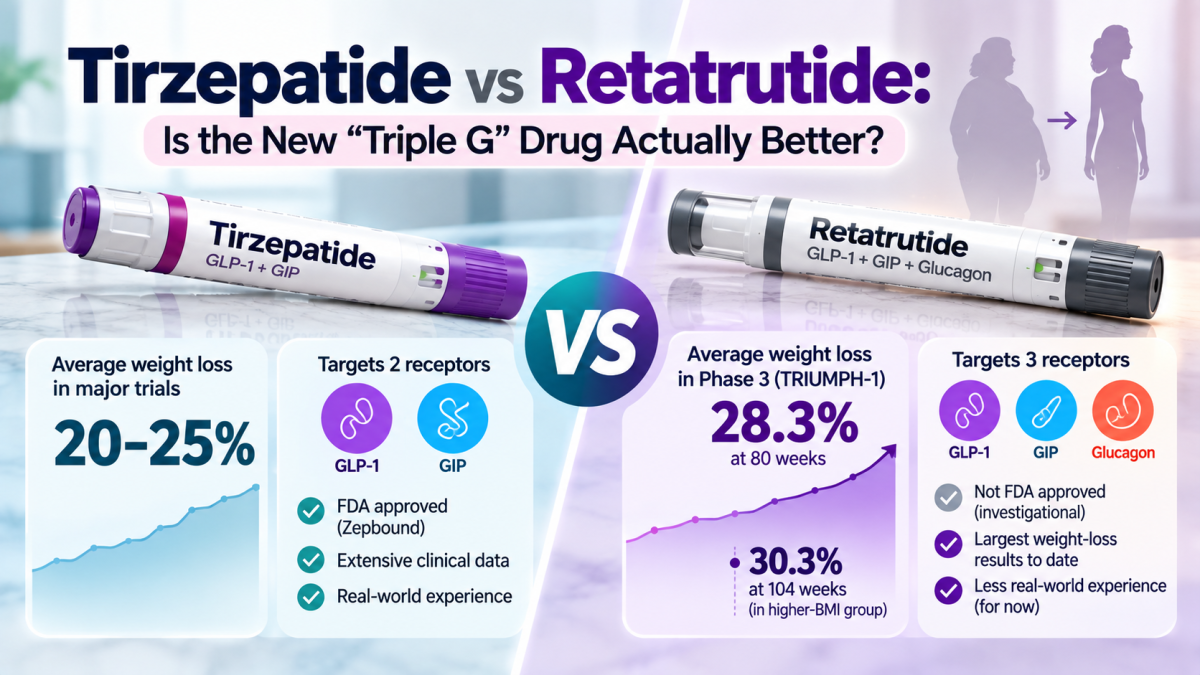
In the Phase 3 TRIUMPH-1 obesity trial, people taking retatrutide 12 mg lost an average of 28.3% of their starting body weight over 80 weeks.
Among participants with a baseline BMI of at least 35 who continued into an extension, average weight loss reached 30.3% at 104 weeks.
Those are extraordinary numbers for a medication trial and push pharmacologic weight loss closer to territory historically associated with bariatric surgery.
What Does Tirzepatide Do by Comparison?
Tirzepatide is hardly weak.
In SURMOUNT-1, average weight loss at 72 weeks reached 15.0% with 5 mg, 19.5% with 10 mg, and 20.9% with 15 mg.
In later trials with longer treatment, average losses with tirzepatide have reached roughly the mid-20% range in some populations.
So the comparison is not between an effective drug and an ineffective one. It is between one of the strongest approved obesity drugs available and a next-generation investigational drug that may push average weight loss even further.
Why Is Retatrutide Called a “Triple G” Drug?
The nickname comes from the three hormone receptors it targets.
- 1GLP-1 receptor
- 2GIP receptor
- 3Glucagon receptor
Tirzepatide targets two: GLP-1 and GIP. Retatrutide adds glucagon receptor activity, which is the major biological difference behind the “triple agonist” label.
The theory is that combining appetite reduction and incretin effects with glucagon-related effects on energy expenditure and metabolism may produce even greater weight loss.
But Three Receptors Does Not Automatically Mean Three Times Better
The receptor count makes a great headline. Biology is messier.
Retatrutide is not simply tirzepatide plus one extra switch. Each receptor is activated with a particular pharmacologic balance, and efficacy depends on how those signals interact in the human body.
The reason retatrutide is exciting is not that three is automatically better than two. It is that the actual trial results have been unusually large.
The Retatrutide Numbers Are Getting Hard to Ignore
The early Phase 2 obesity trial already attracted attention when the 12 mg group lost an average of 24.2% at 48 weeks.
At that point, 26% of participants receiving 12 mg had lost at least 30% of their starting body weight.
Phase 3 then pushed the average even higher: 28.3% with 12 mg at 80 weeks in TRIUMPH-1.
At that dose, 45.3% of participants reached at least 30% weight loss.
What the Numbers Look Like at a 250-Pound Starting Weight
Trial percentages become easier to understand when translated into pounds.
- 120.9% weight loss = about 52 lb from a 250-lb starting weight
- 224.2% weight loss = about 61 lb
- 328.3% weight loss = about 71 lb
- 430.3% weight loss = about 76 lb
Those examples are illustrations based on study averages, not predictions for what one person will lose.
Can We Really Compare 28.3% With 20.9%?
Not as cleanly as the numbers make it look.
The 20.9% tirzepatide figure comes from SURMOUNT-1 at 72 weeks. The 28.3% retatrutide figure comes from TRIUMPH-1 at 80 weeks. These were separate studies with different participants, protocols, treatment durations, and trial conditions.
Cross-trial comparisons are useful for seeing the broad signal, but they cannot tell us exactly how much more weight the same person would lose on retatrutide instead of tirzepatide.
There Is Still No Big Tirzepatide-vs-Retatrutide Head-to-Head Trial
This is the single most important limitation in the comparison.
Unlike tirzepatide versus semaglutide, where SURMOUNT-5 directly randomized participants to one drug or the other, the retatrutide comparison still relies heavily on indirect evidence.
So it is reasonable to say retatrutide currently appears to produce greater average weight loss. It is premature to say it has definitively beaten tirzepatide in a direct contest.
The 2026 Network Meta-Analyses Also Put Retatrutide Near the Top
Indirect comparative analyses are starting to reinforce the same pattern.
A network meta-analysis of randomized trials in adults with overweight or obesity without diabetes estimated weight reduction versus placebo at about 22.1% for retatrutide and 19.3% for tirzepatide.
Retatrutide ranked highest for weight loss in that analysis, with tirzepatide next.
But the confidence intervals overlap, treatment durations differ, and indirect rankings do not carry the same certainty as a randomized head-to-head trial.
A Bigger BMJ Analysis Was More Cautious
A 2026 BMJ network meta-analysis covering 262 randomized trials and nearly 100,000 participants reached a more conservative conclusion.
It found moderate-to-high certainty evidence supporting tirzepatide as one of the most effective established options, while describing the evidence for emerging agents including retatrutide as promising but lower certainty.
That is a useful reminder that spectacular numbers and mature evidence are not the same thing.
Tirzepatide Has One Huge Advantage: We Already Know Much More About It
Tirzepatide has already moved far beyond the experimental stage.
- 1It has regulatory approval for obesity treatment under Zepbound
- 2It is widely used in clinical practice
- 3It has large Phase 3 trial programs
- 4It has direct head-to-head evidence against semaglutide
- 5It has growing real-world effectiveness and safety data
- 6Clinicians have years of practical experience with dose escalation and tolerability
Retatrutide may ultimately outperform it on average weight loss, but tirzepatide currently wins decisively on maturity of evidence and real-world experience.
Retatrutide Is Still Investigational
As of 2026, retatrutide is not an FDA-approved obesity medication.
Lilly has reported positive Phase 3 results and plans regulatory submission, but that is not the same as approval.
That distinction matters because internet searches for retatrutide already lead to websites claiming to sell it. Trial-grade investigational retatrutide and an unapproved product sold online are not interchangeable.
What About Side Effects?
Retatrutide and tirzepatide share a familiar gastrointestinal side-effect pattern.
- 1Nausea
- 2Diarrhea
- 3Vomiting
- 4Constipation
- 5Reduced appetite and gastrointestinal discomfort
In the retatrutide Phase 2 trial, gastrointestinal events were the most common adverse effects, were generally mild to moderate, and were more frequent at higher doses.
Dose-dependent increases in heart rate were also observed with retatrutide, peaking around week 24 and declining afterward. That is one safety signal researchers have been watching carefully as the program has moved into larger Phase 3 studies.
Does More Weight Loss Automatically Mean a Better Drug?
No.
The largest average percentage on the scale is only one outcome.
- 1Side effects and treatment discontinuation
- 2Long-term cardiovascular outcomes
- 3Effects on diabetes and other obesity-related conditions
- 4Lean-mass preservation and body composition
- 5Durability of weight loss
- 6What happens after treatment stops
- 7Cost and insurance coverage
- 8Availability
- 9Long-term safety experience
Retatrutide may eventually lead some of these categories too. Right now, many of them are simply less mature than the weight-loss efficacy data.
Could Retatrutide Reach Bariatric-Surgery-Level Weight Loss?
This is where much of the excitement comes from.
In TRIUMPH-1, nearly half of participants receiving 12 mg lost at least 30% of their starting body weight by 80 weeks, and the average in a higher-BMI extension reached about 30% by 104 weeks.
Those numbers overlap with the range people often associate with metabolic surgery, but medication and surgery are not interchangeable treatments and should not be compared by weight-loss percentage alone.
Would Someone on Tirzepatide Eventually Switch to Retatrutide?
That is likely to become a major real-world question if retatrutide is approved.
Someone who is doing well on tirzepatide would not automatically need to abandon an effective treatment simply because another drug produces a higher trial average.
The more interesting future group may be people who have plateaued, remain well above their treatment goal, or cannot achieve enough benefit with currently available therapy.
But until retatrutide is approved and switching strategies are properly studied, this remains a future treatment question rather than a current do-it-yourself decision.
Tirzepatide vs Retatrutide: Where Things Stand in 2026
- 1Average weight loss: current indirect evidence favors retatrutide
- 2Receptors targeted: tirzepatide targets GIP + GLP-1; retatrutide targets GIP + GLP-1 + glucagon
- 3Approval status: tirzepatide is approved; retatrutide remains investigational
- 4Real-world experience: strongly favors tirzepatide
- 5Long-term evidence: currently much deeper for tirzepatide
- 6Maximum Phase 3 obesity result reported: retatrutide has reached about 28.3% average loss at 80 weeks and about 30.3% in an extension population
- 7Direct tirzepatide-vs-retatrutide randomized trial: not yet available
So Is Retatrutide Actually Better?
For pure average weight-loss potential, retatrutide currently looks like the stronger drug.
Its Phase 3 results are larger than the headline results from the major tirzepatide obesity trials, and indirect network analyses generally rank retatrutide at or near the top.
But “better” is a bigger claim than “more weight loss.” Tirzepatide is approved, widely studied, used in the real world, and supported by a much more mature evidence base. Retatrutide remains investigational, and we still do not have the clean randomized head-to-head trial that would settle the comparison.
The Bottom Line
Retatrutide may be the first obesity drug to make average 30% weight loss look realistic for a meaningful number of patients.
That makes the comparison with tirzepatide impossible to ignore. Right now, retatrutide appears to have the higher weight-loss ceiling, while tirzepatide has the much stronger advantage in approval status, clinical experience, and maturity of evidence.
The most accurate 2026 answer is therefore: retatrutide looks more powerful, but it has not yet definitively beaten tirzepatide head-to-head.
Frequently Asked Questions
Current indirect evidence suggests that it may. Retatrutide produced 28.3% average weight loss at 80 weeks with 12 mg in the Phase 3 TRIUMPH-1 trial, while major tirzepatide obesity trials have generally reported lower average percentages. However, there is not yet a large randomized head-to-head trial directly comparing the two drugs.
Tirzepatide activates the GIP and GLP-1 receptors. Retatrutide activates GIP, GLP-1, and glucagon receptors, making it a triple-hormone-receptor agonist.
The nickname refers to its activity at three receptors: GIP, GLP-1, and glucagon. It is sometimes described as a triple agonist or triple-hormone-receptor agonist.
In TRIUMPH-1, average weight loss at 80 weeks was 19.0% with 4 mg, 25.9% with 9 mg, and 28.3% with 12 mg. In a study extension among participants with baseline BMI of at least 35, average loss reached about 30.3% at 104 weeks with 12 mg.
No. As of 2026, retatrutide remains investigational. Positive Phase 3 results have been reported, but regulatory submission and review still need to occur before it can become an approved prescription obesity treatment.
Retatrutide is not an FDA-approved medication as of 2026. Products marketed online as retatrutide are not equivalent to receiving an approved prescription product with established manufacturing, dosing, and regulatory oversight.
Retatrutide is still investigational, so it is not currently an approved alternative to switch to. If it receives approval in the future, whether switching makes sense will depend on response to tirzepatide, side effects, medical history, access, and evidence from future studies.
Sources
This article is based on published retatrutide research, 2026 Phase 3 results, and comparative evidence reviews:
- 1Jastreboff AM, et al. Triple–Hormone-Receptor Agonist Retatrutide for Obesity — A Phase 2 Trial. New England Journal of Medicine.
- 2Eli Lilly and Company. TRIUMPH-1 Phase 3 topline results, 2026.
- 3Comparative effects of drugs for adults with overweight or obesity: systematic review and network meta-analysis. BMJ. 2026.
- 4Comparative efficacy and safety of GLP-1-based drugs for weight loss in adults with overweight or obesity without diabetes: network meta-analysis of randomized controlled trials. 2026.
Retatrutide remains investigational, and cross-trial comparisons cannot establish that it is superior to tirzepatide for an individual patient. Written for general education; this page is not medical advice. Tirzepatide.review is independent and is not affiliated with, sponsored by, or endorsed by Eli Lilly and Company.

Nataliia Bondarchuk
Author
Comments (0)
Be the first to comment on this article.
More articles