
Tirzepatide Dosage for Weight Loss: 2.5 mg vs 5 mg vs 10 mg vs 15 mg
Tirzepatide dosage for weight loss: the 2.5 mg start, 2.5 mg steps every 4 weeks, 5, 10 and 15 mg maintenance doses, and what results look like by dose.
Tirzepatide Dosage for Weight Loss: 2.5 mg vs 5 mg vs 10 mg vs 15 mg
Higher tirzepatide doses generally produced more weight loss in clinical trials — but that does not mean everyone should race to 15 mg. The usual starting dose is 2.5 mg once weekly for four weeks, then 5 mg. For weight reduction, 5 mg, 10 mg, and 15 mg are recommended maintenance doses, and dose increases are based on both response and tolerability.
The most important thing to understand is that the dose schedule is designed as a progression, not a competition. Some people begin losing weight early at lower doses. Others need more time or a higher maintenance dose. And more medication is only useful if the extra effect is worth the side effects.
Related: tirzepatide weight loss by week, not losing weight on tirzepatide and our side effects guide.
The same dose ladder applies to both brands; see Mounjaro vs Zepbound.
The Tirzepatide Dose Schedule in One Minute
- 1Weeks 1–4: 2.5 mg once weekly
- 2Week 5 onward: 5 mg once weekly
- 3If needed and tolerated: increase by 2.5 mg after at least 4 weeks on the current dose
- 4Possible next steps: 7.5 mg, 10 mg, 12.5 mg, then 15 mg
- 5Recommended maintenance doses for weight reduction: 5 mg, 10 mg, or 15 mg
- 6Maximum recommended dose: 15 mg once weekly
That schedule answers one common misconception immediately: 7.5 mg and 12.5 mg exist, but they are generally dose-escalation steps rather than the labeled maintenance doses for weight reduction.
2.5 mg: The Starting Dose, Not the Finish Line
The 2.5 mg dose is used to start treatment and help the body adjust. It is not an approved maintenance dose for weight reduction.
That does not mean nothing happens at 2.5 mg. Some people notice reduced appetite, earlier fullness, fewer cravings, or movement on the scale during the first month.
But there is an important evidence problem with asking, "How much weight should I lose on 2.5 mg?" The major obesity trial did not randomize people to remain on 2.5 mg long term. Participants assigned to the higher treatment doses moved through the lower doses during escalation.
So there is no clean SURMOUNT-1 number saying that 2.5 mg produces a specific percentage of long-term weight loss.
5 mg: The First True Maintenance Dose
After four weeks at 2.5 mg, the usual next step is 5 mg once weekly.
Unlike 2.5 mg, 5 mg is a recommended maintenance dose for weight reduction. It is also the lowest tirzepatide dose that was studied as a long-term fixed target in SURMOUNT-1.
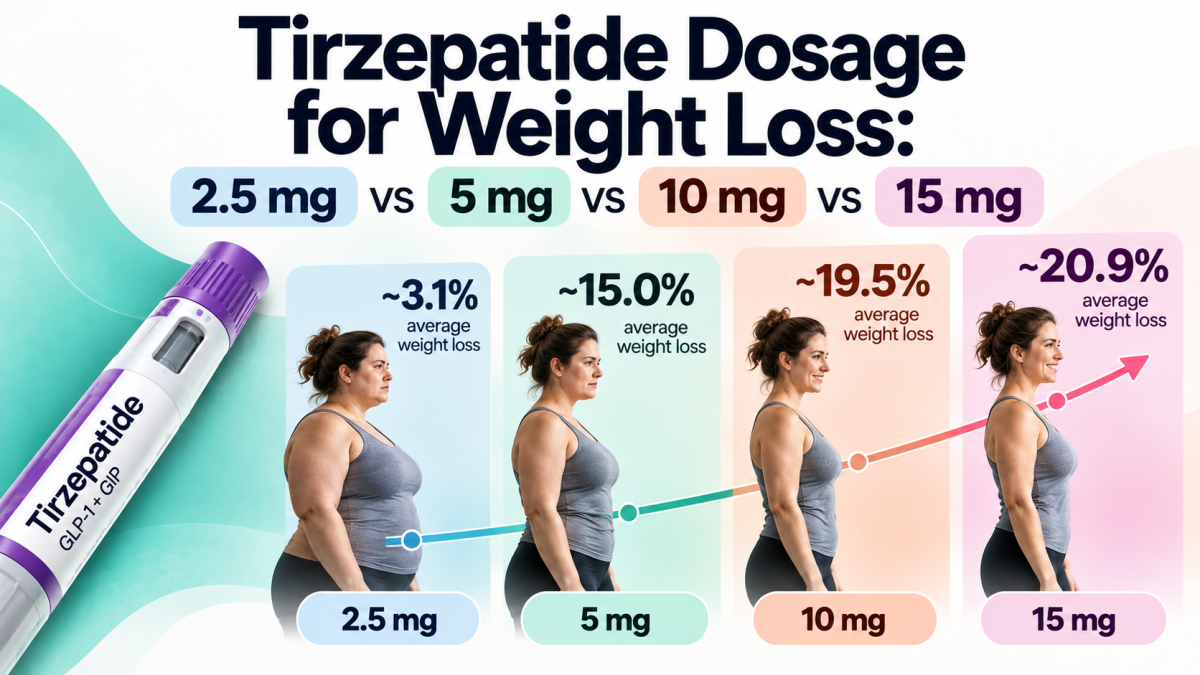
At 72 weeks, participants assigned to 5 mg lost an average of 15.0% of their starting body weight.
That is already a large average reduction. Someone starting at 250 pounds would be looking at roughly 37.5 pounds if they happened to match that trial average.
10 mg: Where the Average Weight Loss Jumped Sharply
The 10 mg group in SURMOUNT-1 lost an average of 19.5% of starting body weight at 72 weeks.
Compared with 5 mg, that is a noticeable difference: 15.0% versus 19.5%. At a 250-pound starting weight, those averages translate to about 37.5 pounds versus 48.8 pounds.
This is one reason people often assume the answer is simply "higher is better." But the dose-response curve does not rise in a perfectly straight line.
15 mg: The Highest Dose — but Not a Magic Dose
The maximum recommended tirzepatide dose is 15 mg once weekly.
In SURMOUNT-1, the 15 mg group lost an average of 20.9% of starting body weight at 72 weeks — the largest average reduction of the three maintenance doses tested.
But notice the shape of the numbers: 5 mg produced 15.0% average loss, 10 mg produced 19.5%, and 15 mg produced 20.9%. The jump from 10 mg to 15 mg was much smaller than the jump from 5 mg to 10 mg.
5 mg vs 10 mg vs 15 mg: The Trial Numbers
- 15 mg — 15.0% average weight loss at 72 weeks
- 210 mg — 19.5% average weight loss at 72 weeks
- 315 mg — 20.9% average weight loss at 72 weeks
- 4Placebo — 3.1% average weight loss at 72 weeks
Those were group averages from adults with obesity or overweight and at least one weight-related complication, without diabetes. Individual results ranged widely.
Does a Higher Tirzepatide Dose Really Mean More Weight Loss?
On average, yes.
SURMOUNT-1 showed a clear dose-response pattern: higher assigned maintenance doses produced greater average weight loss and increased the likelihood of reaching larger weight-loss thresholds.
For example, 30.0% of people in the 5 mg group lost at least 20% of their body weight. That rose to 50.1% with 10 mg and 56.7% with 15 mg.
For at least 25% weight loss, the corresponding figures were 15.3%, 32.3%, and 36.2%.
So the dose effect is real. What is misleading is turning that population-level pattern into the rule that every individual should keep increasing until 15 mg.
Why Not Just Start at 15 mg?
Because the escalation schedule exists for a reason.
Tirzepatide commonly causes gastrointestinal effects such as nausea, diarrhea, constipation, vomiting, and uncomfortable fullness. These problems are particularly relevant while the dose is being increased.
Starting low and increasing gradually gives the body time to adapt and is intended to reduce gastrointestinal adverse reactions.
Jumping ahead because a higher number produced better trial averages is not the same thing as following the studied treatment strategy.
When Does Tirzepatide Start Working for Weight Loss?
Some people notice appetite changes or early weight loss within the first few weeks. But early response varies enough that one month is a poor place to decide whether tirzepatide is "working."
A recent SURMOUNT-1 analysis found that even among people who had lost less than 5% of their weight at week 12, most went on to achieve clinically meaningful weight loss with more time.
Among those slower early responders, 70% had reached at least 5% weight loss by week 24 and 90% had reached it by week 72.
That matters because the early months are also the period when the dose is still being escalated. A slow first eight or twelve weeks does not automatically predict a poor long-term result.
Can You Lose Weight on 2.5 mg?
Yes, some people do.
But it is better to think of that as an individual early response than as proof that 2.5 mg is the ideal long-term dose. The labeled purpose of 2.5 mg is treatment initiation, and the major weight-loss trial did not test 2.5 mg as a long-term maintenance group.
Do You Have to Increase From 5 mg?
Not simply because a calendar says so.
The prescribing information says maintenance-dose selection should consider both treatment response and tolerability. Five milligrams is itself a recommended maintenance dose for weight reduction.
If somebody is losing meaningful weight, appetite control is good, and side effects are manageable, there is no universal rule that they must continue climbing toward 15 mg.
What About 7.5 mg and 12.5 mg?
These doses are real, but they create confusion because people often assume every available strength is a standard maintenance target.
For weight reduction, the labeled maintenance doses are 5 mg, 10 mg, and 15 mg. The 7.5 mg and 12.5 mg strengths allow dose escalation in 2.5 mg steps.
A clinician may make individualized decisions based on tolerability and response, but the official weight-management maintenance targets should not be confused with every strength sold.
Is 15 mg Always Better Than 10 mg?
Not necessarily for an individual person.
The 15 mg group lost slightly more weight on average than the 10 mg group in SURMOUNT-1: 20.9% versus 19.5%. But those averages overlap with a huge range of individual experiences.
Someone doing extremely well on 10 mg may gain little from moving higher. Someone else may benefit from additional escalation. Someone may also find that a higher dose causes side effects that make treatment harder to sustain.
More Dose Can Also Mean More Tolerability Problems
In SURMOUNT-1, gastrointestinal side effects were common and occurred mainly during dose escalation.
Treatment discontinuation because of adverse events occurred in 4.3% of participants assigned to 5 mg, 7.1% assigned to 10 mg, and 6.2% assigned to 15 mg, compared with 2.6% on placebo.
Those numbers do not form a perfectly dose-dependent line, which is another reminder that tolerability is more complicated than "higher dose equals worse side effects."
The Best Dose Is Not Necessarily the Highest Dose
The useful dose is the one that produces enough benefit while remaining tolerable and sustainable.
That sounds less exciting than "15 mg burns the most weight," but it is much closer to how treatment actually works.
A person already losing steadily on 5 mg does not have the same situation as someone whose appetite suppression has faded and whose weight has been flat for months. Dose decisions make more sense when they respond to the person rather than chasing the maximum number on the pen.
Does Weight Loss Stop When You Stay on the Same Dose?
Not automatically.
Weight loss can continue for months on a stable dose. In SURMOUNT-1, the weight curves continued downward well beyond the early titration period, and later analyses found that many participants did not reach a weight plateau until months into treatment.
A temporary flat week or even a short plateau is therefore not automatic evidence that the dose has "stopped working."
What If You Are Losing Weight Faster Than Expected?
Faster is not always better.
Rapid weight loss can make it harder to preserve lean mass, maintain nutrition, and tolerate treatment. Persistent vomiting, inability to eat or drink adequately, severe abdominal symptoms, or signs of dehydration are not signs that the medication is simply "working extra well."
Those are reasons to discuss the dose and symptoms with a healthcare professional rather than automatically continuing an escalation schedule.
What the Dose Numbers Actually Tell Us
The clearest interpretation of the evidence is surprisingly simple.
- 12.5 mg is the starting dose used to begin treatment
- 25 mg is the first recommended maintenance dose for weight reduction
- 310 mg produced substantially greater average weight loss than 5 mg in SURMOUNT-1
- 415 mg produced the greatest average weight loss, but only modestly more than 10 mg
- 5Higher doses increase the chance of very large weight-loss responses at the population level
- 6The best individual dose still depends on response and tolerability
New to tirzepatide? Start with how Zepbound works, a plain-English explanation of the GLP-1 and GIP mechanism behind these results.
These doses come in three forms: the single-dose autoinjector, self-pay vials and, since February 2026, a four-dose multi-dose pen. We compare doses per device, price and storage in Zepbound KwikPen explained.
The dose is only half of a correct injection; the other half is where and how it goes in. Site choice, weekly rotation, device differences and what to do about leaks, bleeding and lumps are covered in where to inject tirzepatide.
People moving over from a semaglutide product often ask where they will start on tirzepatide. Our guide to switching from semaglutide to tirzepatide covers what to discuss with your prescriber.
The Bottom Line
Yes, higher tirzepatide doses generally caused more weight loss in the major obesity trial. At 72 weeks, average weight loss was 15.0% with 5 mg, 19.5% with 10 mg, and 20.9% with 15 mg.
But that does not make 15 mg the automatic goal. Tirzepatide starts at 2.5 mg to improve tolerability, 5 mg is already a real maintenance dose, and dose increases should reflect what is happening with weight, appetite, side effects, and overall treatment response.
The smartest way to read the dose-response data is not "more is always better." It is "higher doses can produce more weight loss on average — when a higher dose is actually needed and tolerated."
Frequently Asked Questions
There is no reliable long-term percentage specifically for 2.5 mg because it is a treatment-initiation dose rather than an approved maintenance dose for weight reduction, and SURMOUNT-1 did not keep a group on 2.5 mg for the full trial. Some people do begin losing weight during the first month.
In SURMOUNT-1, participants assigned to 5 mg once weekly lost an average of 15.0% of their starting body weight at 72 weeks.
On average, the difference was meaningful in SURMOUNT-1. Average weight loss was 19.5% with 10 mg compared with 15.0% with 5 mg at 72 weeks. Individual results can be very different from those averages.
It produced the greatest average weight loss in SURMOUNT-1, at 20.9% over 72 weeks, but it is not automatically the best dose for every person. Treatment response and tolerability both matter.
No. Dose increases can occur in 2.5 mg steps after at least four weeks on the current dose, but maintenance-dose selection should consider response and tolerability. Five, 10, and 15 mg are recommended maintenance doses for weight reduction.
For Zepbound weight reduction, the labeled maintenance doses are 5 mg, 10 mg, and 15 mg. The 7.5 mg and 12.5 mg strengths are part of the 2.5 mg-step dose-escalation pathway.
Some people notice changes within the first few weeks, while others respond more slowly. SURMOUNT-1 analyses show that a slower early response does not necessarily mean treatment will fail: many people who had lost less than 5% at week 12 went on to achieve meaningful loss later.
Not automatically. Short plateaus can occur even while treatment remains effective. Whether a dose increase makes sense depends on how long the plateau has lasted, appetite control, side effects, current dose, and the overall treatment plan.
Sources
This article is based primarily on current U.S. prescribing information and randomized clinical trial evidence:
- 1U.S. Food and Drug Administration. Zepbound (tirzepatide) Prescribing Information.
- 2Jastreboff AM, et al. Tirzepatide Once Weekly for the Treatment of Obesity. New England Journal of Medicine.
- 3Jastreboff AM, et al. Weight reduction over time in tirzepatide-treated participants by early weight loss response: Post hoc analysis in SURMOUNT-1.
- 4Horn DB, et al. Time to weight plateau with tirzepatide treatment in the SURMOUNT-1 and SURMOUNT-4 clinical trials.
Clinical trial averages are not predictions for an individual person. Tirzepatide dose changes should be made with a qualified healthcare professional and according to the prescribed product instructions. Written for general education; this page is not medical advice. Tirzepatide.review is independent and is not affiliated with, sponsored by, or endorsed by Eli Lilly and Company.

Nataliia Bondarchuk
Author
Comments (0)
Be the first to comment on this article.
More articles