
What Comes After Tirzepatide? EloraTZP, Retatrutide and the Next Generation of Weight-Loss Drugs
What comes after tirzepatide: EloraTZP, retatrutide, amylin drugs and oral GLP-1 pills, and how the next weight-loss drugs could change treatment.
What Comes After Tirzepatide? EloraTZP, Retatrutide and the Next Generation of Weight-Loss Drugs
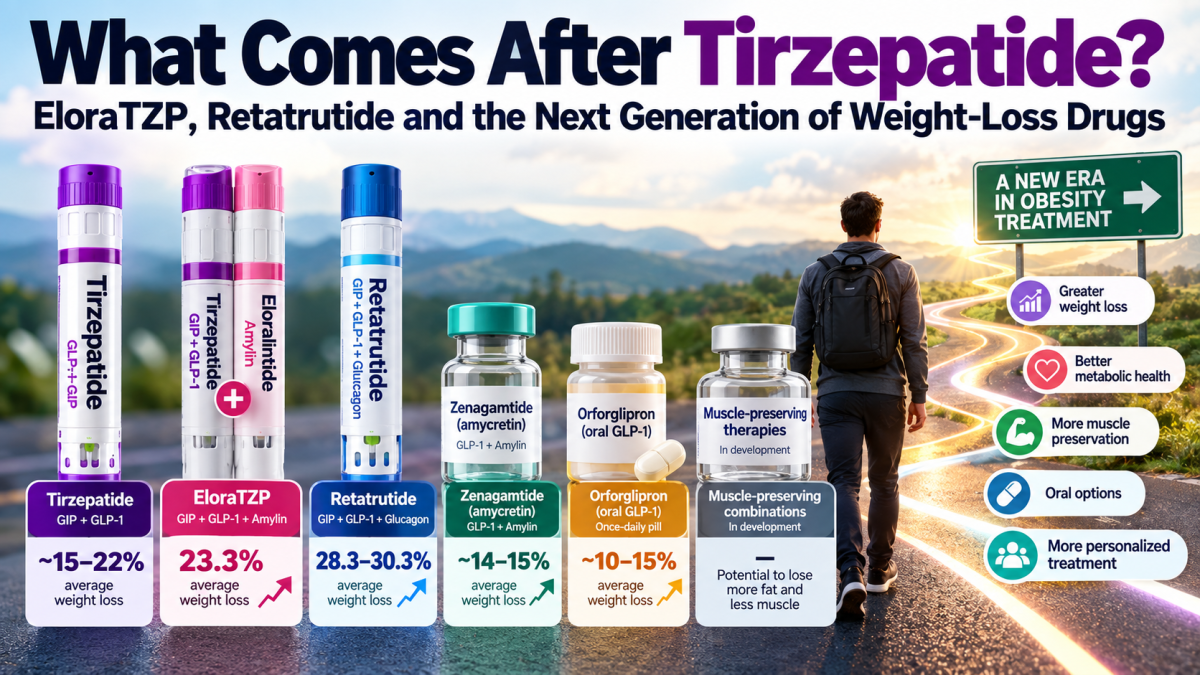
Tirzepatide may not be the end of the weight-loss drug revolution. By late 2026, the next generation is already taking shape: retatrutide is pushing average weight loss toward 30%, EloraTZP has beaten tirzepatide alone in a Phase 2 diabetes trial, amylin-based drugs are moving into Phase 3, and oral GLP-1 treatments are making injections less central to the category.
The most interesting change is that drug developers are no longer asking only, "Can we suppress appetite more?" They are combining different metabolic signals to chase greater weight loss, better blood sugar control, better body composition, fewer injections, and potentially more individualized treatment.
Related: tirzepatide vs retatrutide and tirzepatide vs semaglutide.
Wondering whether tirzepatide itself comes as a tablet? See is there a tirzepatide pill.
The Surprise of 2026: Tirzepatide Became the Starting Point
Only a few years ago, tirzepatide itself looked like the next-generation drug.
Its combination of GIP and GLP-1 receptor activity helped push medication-induced weight loss far beyond what earlier obesity drugs had typically achieved.
Now researchers are using that success as a base layer: add amylin, add glucagon, redesign delivery, or combine weight loss with muscle-preserving biology.
EloraTZP: What Happens When You Add Amylin to Tirzepatide?
EloraTZP is not a completely new single molecule. It is an investigational combination of tirzepatide with eloralintide, a selective amylin receptor agonist.
Tirzepatide already targets GIP and GLP-1. Eloralintide adds an amylin pathway involved in satiety and calorie intake. Together, the combination is designed to activate three complementary nutrient-responsive hormonal systems.
23.3% Weight Loss in 48 Weeks Got Everyone's Attention
In September 2026, Lilly reported results from a 48-week Phase 2b study involving 367 adults with obesity or overweight and type 2 diabetes.
The highest studied EloraTZP combination — eloralintide 9 mg plus tirzepatide 15 mg — produced an average 23.3% reduction in body weight.
The tirzepatide 15 mg arm lost 14.8% over the same 48 weeks.
That is an 8.5-percentage-point difference in a population with type 2 diabetes — a group that often loses less weight on incretin-based therapy than people without diabetes.
The EloraTZP Results Were Not Just About Weight
The highest-dose combination also reduced A1C by an average of 2.9 percentage points, compared with 2.4 points for tirzepatide 15 mg alone.
That is important because next-generation obesity medications are increasingly being judged not only by kilograms lost, but by what they do to the wider metabolic disease that often travels with obesity.
But EloraTZP Also Revealed the Trade-Off
More weight loss did not come free.
Gastrointestinal adverse events were more frequent in the combination groups than with either eloralintide or tirzepatide alone. Most were described as mild or moderate and occurred mainly during dose escalation.
Discontinuation because of adverse events ranged from 10.8% to 27.0% across the EloraTZP combination groups, compared with 2.9% in the tirzepatide-alone arm.
That may become one of the defining questions of the next obesity-drug era: how much extra efficacy is worth how much extra tolerability burden?
Lilly Is Already Changing the Dosing Strategy
In the Phase 2 study, eloralintide and tirzepatide were given as separate injections.
Lilly says the next step is a co-formulated EloraTZP product entering Phase 3 with an optimized dose-escalation schedule.
That detail matters. If slower or redesigned titration can preserve the weight-loss advantage while reducing discontinuations, the Phase 3 version of EloraTZP may look meaningfully different from the Phase 2 experiment.
Eloralintide Is Also Being Developed Without Tirzepatide
Eloralintide itself is a major part of the story.
In a Phase 2 study of adults with obesity or overweight without type 2 diabetes, once-weekly eloralintide produced mean weight reductions ranging from 9.5% to 20.1% at 48 weeks, depending on the dose strategy.
That was strong enough for Lilly to move eloralintide into Phase 3 as a standalone obesity treatment as well as continue developing it in combination with tirzepatide.
Retatrutide Takes a Completely Different Route
Retatrutide is another way of asking what comes after tirzepatide.
Instead of combining tirzepatide with a second drug, retatrutide is a single molecule designed to activate three receptors: GIP, GLP-1, and glucagon.
That extra glucagon activity is intended to add another metabolic lever beyond the dual GIP/GLP-1 mechanism of tirzepatide.
Retatrutide Is Already Pushing Toward 30%
In the Phase 3 TRIUMPH-1 obesity trial, the 12 mg retatrutide group lost an average of 28.3% of starting body weight over 80 weeks.
Among participants with a baseline BMI of at least 35 who entered an extension, average weight loss reached 30.3% at 104 weeks.
That is currently one of the clearest signals that medication-induced weight loss may be moving into a range once associated much more strongly with metabolic surgery.
Retatrutide Is Further Along Than EloraTZP
The two programs should not be treated as if they are at the same stage.
Retatrutide has already produced multiple positive Phase 3 trials. Lilly has said it plans to submit the drug to the FDA for obesity in the first quarter of 2027.
EloraTZP, by contrast, is only now moving from Phase 2 into Phase 3.
EloraTZP vs Retatrutide: Do Not Compare the Percentages Too Literally
It is tempting to line up 23.3% for EloraTZP and 28.3% for retatrutide and declare a winner.
That would be misleading.
The EloraTZP result came from 48 weeks in adults with type 2 diabetes. The 28.3% retatrutide result came from 80 weeks in adults without diabetes. Those are very different trial populations and treatment durations.
EloraTZP's most interesting feature is not that its current number is higher or lower than retatrutide. It is that adding amylin produced substantially more weight loss than tirzepatide alone within the same randomized trial.
The Next Battle May Be Amylin vs Glucagon — or Both
The pipeline is starting to reveal two major strategies beyond classic GLP-1 treatment.
- 1Add glucagon activity to GIP + GLP-1, as retatrutide does
- 2Add amylin activity to incretin treatment, as EloraTZP does
Both approaches attempt to recruit more of the body's metabolic signaling network rather than pushing one receptor harder and harder.
Novo Nordisk Is Building Around Amylin Too
Lilly is not alone in betting that amylin will matter.
Novo Nordisk is developing zenagamtide, previously known as amycretin, a single molecule that activates both GLP-1 and amylin receptors.
In a Phase 2 study in adults with type 2 diabetes, subcutaneous zenagamtide produced up to roughly 14.5% to 14.6% weight loss at 36 weeks, and the program is advancing into Phase 3.
That does not yet rival the headline retatrutide numbers, but it reinforces a broader trend: amylin has moved from a niche concept into one of the central targets of the next obesity-drug cycle.
The Next Generation Is Not Only About Losing More Weight
The most powerful drug is not automatically the most useful drug.
Future obesity treatments are increasingly being judged on a much bigger scorecard.
- 1How much total weight is lost
- 2How much of that loss is fat versus lean tissue
- 3Whether people can tolerate the medication long term
- 4Cardiovascular outcomes
- 5Diabetes control
- 6Sleep apnea and other obesity-related conditions
- 7Whether treatment can be taken orally
- 8How easy the dose escalation is
- 9Whether weight loss can be maintained
- 10Cost, manufacturing capacity, and access
Oral Drugs Could Be Just as Disruptive as Stronger Injections
Not every next-generation drug needs to beat tirzepatide on percentage weight loss.
Orforglipron, marketed in the U.S. as Foundayo in 2026, represents another direction: a once-daily small-molecule oral GLP-1 that can be taken without food or water timing restrictions.
Its weight-loss percentages are generally lower than the most powerful injectable multi-agonists, but convenience can be its own form of disruption.
A pill that is easier to manufacture, distribute, store, and take could reach people who would never choose or obtain a weekly injectable.
The Really Big Shift: Quality of Weight Loss
By 2026, the market is beginning to move beyond the scale.
Large weight losses can include lean tissue as well as fat. That has created an entirely new research race around preserving muscle while obesity drugs remove fat.
Experimental myostatin-targeting therapies are already being combined with incretin drugs to test whether future treatment can deliver similar scale loss with better lean-mass preservation.
The Future May Be Combination Therapy, Not One Miracle Drug
Obesity treatment may eventually start looking more like hypertension or cancer treatment: different pathways used in different combinations for different patients.
One person may need the strongest possible weight reduction. Another may prioritize tolerability. Another may have type 2 diabetes. Another may be older and need aggressive muscle preservation. Another may strongly prefer a pill.
The next generation may therefore be less about finding one drug that replaces everything and more about building a larger menu of metabolic tools.
Where the Major Next-Generation Drugs Stand in Late 2026
- 1Tirzepatide — approved dual GIP + GLP-1 treatment with extensive Phase 3 and real-world experience
- 2Retatrutide — investigational GIP + GLP-1 + glucagon triple agonist with multiple positive Phase 3 trials; regulatory submission planned for 2027
- 3Eloralintide — investigational selective amylin receptor agonist advancing through Phase 3
- 4EloraTZP — investigational eloralintide + tirzepatide combination moving into Phase 3 after positive Phase 2b results
- 5Zenagamtide (amycretin) — investigational GLP-1 + amylin agonist advancing in Phase 3 programs
- 6Oral small-molecule GLP-1 drugs — focused on making effective obesity treatment easier to take and scale
Could EloraTZP Eventually Beat Retatrutide?
We do not know.
The current EloraTZP and retatrutide results come from different populations, different trial phases, and different treatment durations. There is no randomized EloraTZP-versus-retatrutide trial.
What EloraTZP has already shown is arguably more important: tirzepatide's effect can apparently be pushed materially further by adding another hormonal pathway.
Does This Make Tirzepatide Obsolete?
No.
A drug does not become clinically irrelevant every time a newer trial produces a bigger percentage.
Tirzepatide is approved, widely used, effective, and supported by mature safety and outcome data. A next-generation therapy would need to show that its extra benefit is worth any extra side effects, complexity, cost, and uncertainty.
The future is more likely to expand the treatment ladder than erase its current rungs.
What Could Change in 2027?
Retatrutide could move from an investigational drug toward regulatory approval. EloraTZP Phase 3 trials should begin generating a much clearer picture of whether its striking Phase 2 advantage survives in larger studies.
Amylin-based competitors will mature, oral drugs will compete on convenience, and muscle-preserving combinations will test whether future obesity treatment can improve body composition rather than simply produce a smaller number on the scale.
That makes 2027 less likely to be the year of one new miracle drug and more likely to be the year obesity pharmacology starts fragmenting into distinct treatment strategies.
The Bottom Line
Tirzepatide changed expectations for what a weight-loss medication could do. The drugs coming after it are now changing expectations again.
Retatrutide is pushing average weight loss toward 30%. EloraTZP has shown that adding an amylin agonist to tirzepatide can produce substantially greater weight loss than tirzepatide alone. Zenagamtide and other amylin programs are expanding the same idea, while oral drugs and muscle-preserving combinations are competing on dimensions other than raw efficacy.
The next question in obesity medicine may no longer be simply, "What replaces tirzepatide?" It may be, "Which combination of mechanisms is best for this particular person?"
Frequently Asked Questions
EloraTZP is an investigational combination of tirzepatide and eloralintide. Tirzepatide activates GIP and GLP-1 receptors, while eloralintide is a selective amylin receptor agonist. Lilly plans to develop the combination as a co-formulated product.
In a 48-week Phase 2b trial in adults with obesity or overweight and type 2 diabetes, the highest studied combination produced 23.3% average weight loss. Tirzepatide 15 mg alone produced 14.8% in the same study.
The Phase 2b study found greater average weight loss with several EloraTZP combinations than with tirzepatide alone, with the highest-dose combination reaching 23.3% versus 14.8%. However, EloraTZP remains investigational and has not yet completed Phase 3 development.
EloraTZP combines two drugs and engages GIP, GLP-1, and amylin pathways. Retatrutide is a single molecule that activates GIP, GLP-1, and glucagon receptors. Retatrutide is further along in development, with multiple completed Phase 3 trials.
Among the major late-stage programs in 2026, retatrutide has reported some of the largest averages, including 28.3% at 80 weeks in TRIUMPH-1 and 30.3% at 104 weeks in a higher-BMI extension group. Cross-trial comparisons should be interpreted cautiously.
No. EloraTZP is investigational. Lilly announced plans to start Phase 3 development of a co-formulated version in late 2026.
Not yet as of late 2026. Retatrutide has completed multiple positive Phase 3 trials, and Lilly has said it plans to submit an application to the FDA in the first quarter of 2027.
Probably not. Tirzepatide already has regulatory approval, extensive clinical evidence, and real-world experience. Newer treatments will need to prove that additional efficacy or convenience outweighs differences in side effects, complexity, access, and long-term evidence.
Sources
This article is based on late-2026 clinical development updates and trial results for tirzepatide, EloraTZP, eloralintide, retatrutide, and other next-generation metabolic therapies:
- 1Eli Lilly and Company. EloraTZP Phase 2b results, September 30, 2026.
- 2Eli Lilly and Company. Retatrutide TRIUMPH-1 Phase 3 results.
- 3Eli Lilly and Company. Retatrutide TRIUMPH-2 and TRIUMPH-3 results.
- 4Eli Lilly and Company. Eloralintide Phase 2 obesity results.
- 5Novo Nordisk. Zenagamtide Phase 2 type 2 diabetes results, 2026.
Most of the medicines discussed on this page remain investigational, and development programs, regulatory timelines, doses, and final safety profiles can change. Cross-trial weight-loss percentages should not be treated as direct comparisons unless drugs were tested against each other in the same randomized study. Written for general education; this page is not medical advice. Tirzepatide.review is independent and is not affiliated with, sponsored by, or endorsed by Eli Lilly, Novo Nordisk, or their products.

Nataliia Bondarchuk
Author
Comments (0)
Be the first to comment on this article.
More articles