Tirzepatide and Muscle Loss: Are You Losing Fat or Lean Muscle?
Does tirzepatide cause muscle loss? What body-composition studies show about fat versus lean mass, and how protein and strength training protect muscle.
Tirzepatide and Muscle Loss: Are You Losing Fat or Lean Muscle?
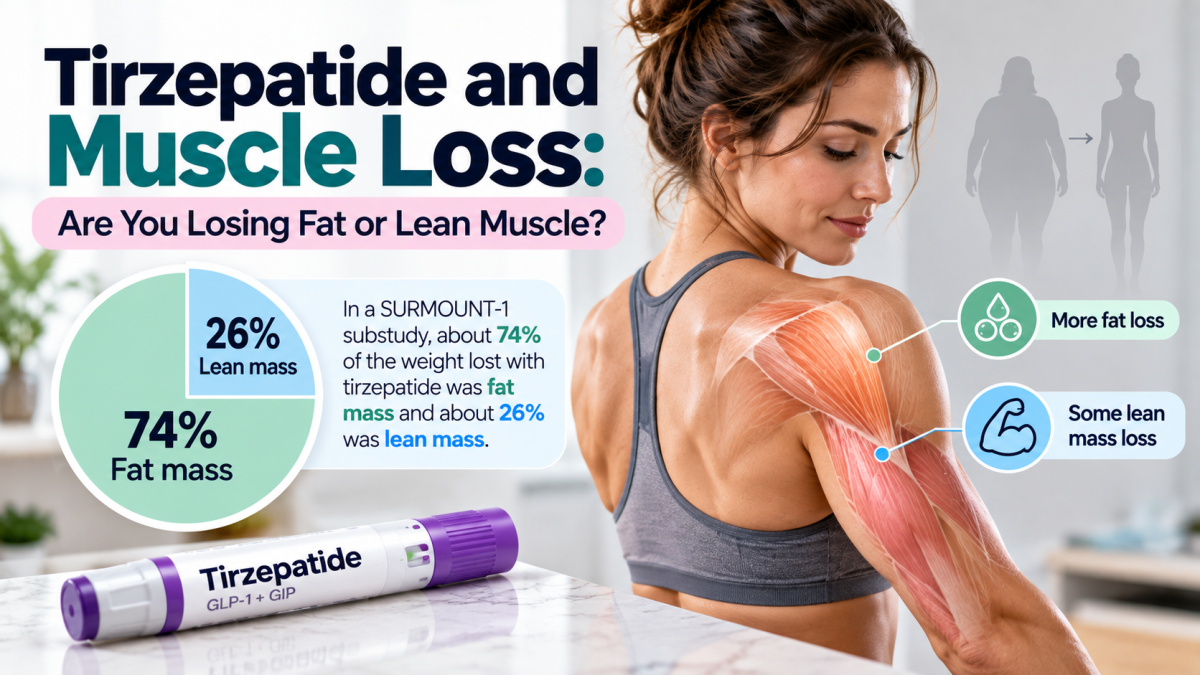
Most of the weight lost on tirzepatide appears to be fat — but not all of it. In a DXA substudy of SURMOUNT-1, about 74% of the weight lost with tirzepatide came from fat mass and about 26% came from lean mass.
That does not mean one quarter of every pound lost was pure skeletal muscle. Lean mass is a broader measurement that includes muscle, water, organs, and other non-fat tissue. Still, preserving muscle while losing a large amount of weight has become one of the biggest questions around GLP-1 and tirzepatide treatment.
The Scale Cannot Tell You What You Are Losing
A scale sees 20 pounds as 20 pounds.
Your body does not.
Twenty pounds lost mostly from body fat is a very different physiological result from twenty pounds that includes a large loss of muscle and other lean tissue.
That is why body composition is becoming a much bigger part of the conversation around powerful weight-loss medications.
What SURMOUNT-1 Actually Found
A body-composition substudy of SURMOUNT-1 used DXA scans to measure fat mass and lean mass before treatment and at 72 weeks.
Among participants treated with tirzepatide, body weight fell by an average of 21.3%. Fat mass fell by 33.9%, while lean mass fell by 10.9%.
In absolute terms, the tirzepatide group lost about 15.9 kg of fat mass and 5.6 kg of lean mass on average.
When researchers divided total weight loss into its components, roughly 74% came from fat mass and 26% from lean mass.
So Is Tirzepatide Burning Muscle?
That is too dramatic a way to describe the evidence.
Losing some lean tissue during substantial weight loss is common, whether the weight is lost through medication, diet, surgery, or another method.
The more useful question is whether the amount of lean tissue being lost is excessive, whether skeletal muscle function is being preserved, and whether certain people are at greater risk than others.
Lean Mass Is Not the Same Thing as Muscle
This distinction matters because headlines often turn "lean mass loss" into "muscle loss" as if the terms were interchangeable.
They are not.
DXA divides the body broadly into fat mass, bone mineral content, and lean soft tissue. Lean mass therefore includes skeletal muscle but also body water, organs, connective tissue, and other non-fat tissue.
A decline in DXA-measured lean mass is real, but it should not automatically be interpreted as the exact amount of contractile muscle someone has lost.
The 75% Fat / 25% Lean Number Needs Context
A headline saying "25% of tirzepatide weight loss is lean mass" can sound alarming.
But in the SURMOUNT-1 substudy, the proportion of weight lost as lean mass was very similar in the placebo group: about 25%.
The major difference was that tirzepatide produced much more total weight loss, so the absolute amount of both fat and lean tissue lost was larger.
In other words, the available trial data do not show that tirzepatide uniquely turns weight loss into muscle loss. They show that dramatic weight reduction includes some loss of lean tissue alongside a much larger loss of fat.
Visceral Fat Fell Even More Dramatically
One number gets much less attention than lean mass: visceral fat.
In the SURMOUNT-1 DXA substudy, visceral fat mass fell by about 40.1% with tirzepatide compared with 7.3% with placebo.
That is important because body composition is not simply a contest between "fat lost" and "muscle lost." Where fat is lost can matter too.
Why Muscle Preservation Matters
Muscle is not just something that changes how your body looks.
- 1It helps maintain strength and physical function
- 2It contributes to glucose disposal and metabolic health
- 3It supports mobility and independence as people age
- 4It affects resting energy expenditure
- 5It can influence how resilient someone is during illness or periods of inactivity
That makes muscle preservation particularly important for older adults, people already starting with low muscle mass, and anyone losing weight very rapidly.
Why 2026 Changed the Conversation
The next generation of obesity research is no longer focused only on making the scale fall faster.
Researchers are now actively testing whether powerful weight-loss treatments can be paired with therapies designed specifically to preserve lean tissue.
The EMBRAZE Trial Put Muscle Preservation to the Test
In 2026, a randomized phase 2 trial called EMBRAZE tested tirzepatide together with apitegromab, an experimental drug that blocks activation of myostatin — a pathway involved in limiting muscle growth.
Participants receiving tirzepatide plus apitegromab lost about 1.9 kg less lean mass than those receiving tirzepatide plus placebo over 24 weeks, despite similar total weight loss.
Researchers estimated that this represented roughly 54.9% preservation of lean mass relative to placebo.
That is scientifically interesting, but apitegromab remains investigational. The result should not be read as a current treatment recommendation.
The Goal Is Becoming Better Weight Loss, Not Just More Weight Loss
This is the bigger story.
A medication that produces 20% weight loss is impressive. A treatment strategy that produces similar weight loss while preserving more muscle could be even more clinically valuable.
That is why newer obesity trials increasingly talk about the quality of weight loss rather than simply the quantity.
Who Might Need to Pay the Most Attention to Muscle?
- 1Older adults
- 2People starting treatment with low muscle mass or frailty
- 3People losing weight very rapidly
- 4People eating very little because of strong appetite suppression
- 5People consuming inadequate protein
- 6People who do little or no resistance exercise
- 7People with illness or mobility limitations that already reduce muscle use
Risk is individual. A healthy younger person who strength trains and eats adequately does not have the same starting point as an older adult with low muscle mass and limited mobility.
Can Eating Too Little Make the Problem Worse?
Potentially, yes.
Tirzepatide can suppress appetite so effectively that some people find themselves eating dramatically less without trying. That may help create the calorie deficit responsible for weight loss, but an extremely low intake can also make adequate protein, vitamins, minerals, and overall nutrition harder to achieve.
Persistent inability to eat enough, repeated vomiting, dehydration, pronounced weakness, or rapid unexplained deterioration in physical function deserves medical attention rather than being treated as proof that the medication is working especially well.
Protein Matters — but There Is No Magic Tirzepatide Protein Number
Protein provides the amino acids needed to maintain and rebuild skeletal muscle.
But there is no single tirzepatide-specific protein target that is correct for everyone. Needs differ with age, body size, activity, kidney function, medical history, total calorie intake, and other factors.
The useful principle is simpler: if appetite suppression is making it difficult to eat enough, protein-rich foods should not become an afterthought.
Resistance Training May Matter More Than Chasing a Perfect Scale Number
Muscle responds to use.
Resistance exercise gives the body a reason to retain and build skeletal muscle during a calorie deficit. That is why strength training is commonly emphasized when the goal is to improve body composition rather than simply reduce body weight.
The important distinction is that evidence supporting resistance exercise for muscle preservation during weight loss is broader than tirzepatide alone. We should not pretend there is a single exercise protocol proven to prevent every kilogram of lean mass loss on tirzepatide.
How Can You Tell If You Are Losing Muscle?
You usually cannot tell from body weight alone.
- 1Noticeable loss of strength over time
- 2Everyday tasks becoming harder rather than easier
- 3Reduced exercise performance
- 4Large reductions in limb circumference alongside rapid weight loss
- 5Body-composition measurements showing declining lean mass
- 6Clinical signs of frailty in higher-risk adults
None of those signs proves that tirzepatide itself caused muscle loss, but they can be reasons to evaluate nutrition, activity, weight-loss speed, and overall health.
Do Smart Scales Accurately Measure Muscle?
Not with the precision their apps sometimes imply.
Consumer bioelectrical-impedance scales estimate body composition using electrical resistance. Hydration, food intake, recent exercise, time of day, and other factors can move the estimate even when actual muscle tissue has barely changed.
They may be more useful for watching long-term trends under similar conditions than for believing that a single reading has measured your muscle to the decimal point.
What About a DXA Scan?
DXA provides a much more useful research-grade picture of fat mass and lean mass than a bathroom scale.
But even DXA measures lean soft tissue rather than directly counting every kilogram of skeletal muscle. It is a body-composition tool, not a perfect muscle biopsy.
Rapid Weight Loss Is Not Automatically Better Weight Loss
The fastest-changing number on the scale is not necessarily the best outcome.
If someone is losing weight so quickly that strength, nutrition, hydration, or daily function is deteriorating, the quality of that weight loss deserves attention.
A slower loss with good strength and adequate nutrition may be a better outcome than a spectacular scale number accompanied by weakness and undernutrition.
Can You Lose Fat While Maintaining Muscle on Tirzepatide?
The evidence suggests that substantial fat loss is absolutely possible — fat accounted for roughly three quarters of the weight lost in the SURMOUNT-1 body-composition substudy.
Completely eliminating lean-tissue loss during major weight reduction is a different question. Research in 2026 is actively testing whether that proportion can be improved.
The Bottom Line
Tirzepatide causes large reductions in body fat, but some lean mass is lost too.
In the SURMOUNT-1 DXA substudy, about 74% of the weight lost was fat mass and about 26% was lean mass. Lean mass is not identical to skeletal muscle, so claims that tirzepatide makes people lose "25% muscle" are misleading.
The bigger lesson for 2026 is that weight-loss quality matters. Preserving strength, muscle function, adequate nutrition, and as much lean tissue as possible is becoming part of the goal — not something to think about only after the scale has already dropped.
Frequently Asked Questions
Tirzepatide treatment is associated with some loss of lean mass during weight loss. In the SURMOUNT-1 DXA substudy, about 26% of the weight lost was lean mass and about 74% was fat mass. Lean mass includes skeletal muscle but is not identical to muscle.
There is no single percentage of skeletal muscle loss that applies to everyone. The best-known SURMOUNT-1 analysis measured lean mass rather than pure skeletal muscle. Lean mass fell by 10.9% on average, and represented about 26% of total weight lost.
Yes, in the SURMOUNT-1 DXA substudy most of the lost weight was fat. About 74% of total weight reduction came from fat mass, compared with about 26% from lean mass.
Resistance training is widely used to support muscle preservation during weight loss because it provides a stimulus for maintaining skeletal muscle. However, there is not yet one tirzepatide-specific training program proven to eliminate lean-mass loss.
Adequate protein is important for maintaining muscle, especially during weight loss, but there is no universal tirzepatide-specific protein target. Individual needs depend on factors such as age, body size, activity, total intake, kidney function, and medical history.
No. Lean mass includes skeletal muscle but also body water, organs, connective tissue, and other non-fat tissues. That is why a DXA result showing lean-mass loss cannot be translated directly into the same amount of skeletal-muscle loss.
Consumer smart scales can estimate body composition, but hydration and other factors can make their muscle or lean-mass readings fluctuate. They are generally more useful for long-term trends than for treating one reading as a precise measurement.
Sources
This article is based primarily on DXA body-composition data from SURMOUNT-1 and emerging 2026 research on preserving lean mass during tirzepatide treatment:
- 1Look M, et al. Body composition changes during weight reduction with tirzepatide in the SURMOUNT-1 study of adults with obesity or overweight. Diabetes, Obesity and Metabolism.
- 2Marantz JL, et al. Apitegromab for lean mass preservation during tirzepatide-induced weight loss: a randomized, double-blind, placebo-controlled phase 2 trial. Nature Medicine. 2026.
- 3Increasing skeletal muscle mass and strength during incretin-based weight loss. 2026.
Body-composition changes vary between individuals, and lean mass is not synonymous with skeletal muscle. Anyone experiencing marked weakness, difficulty maintaining adequate nutrition, or unusually rapid weight loss should discuss those changes with a qualified healthcare professional. Written for general education; this page is not medical advice. Tirzepatide.review is independent and is not affiliated with, sponsored by, or endorsed by Eli Lilly and Company.

Nataliia Bondarchuk
Author
Comments (0)
Be the first to comment on this article.
More articles