
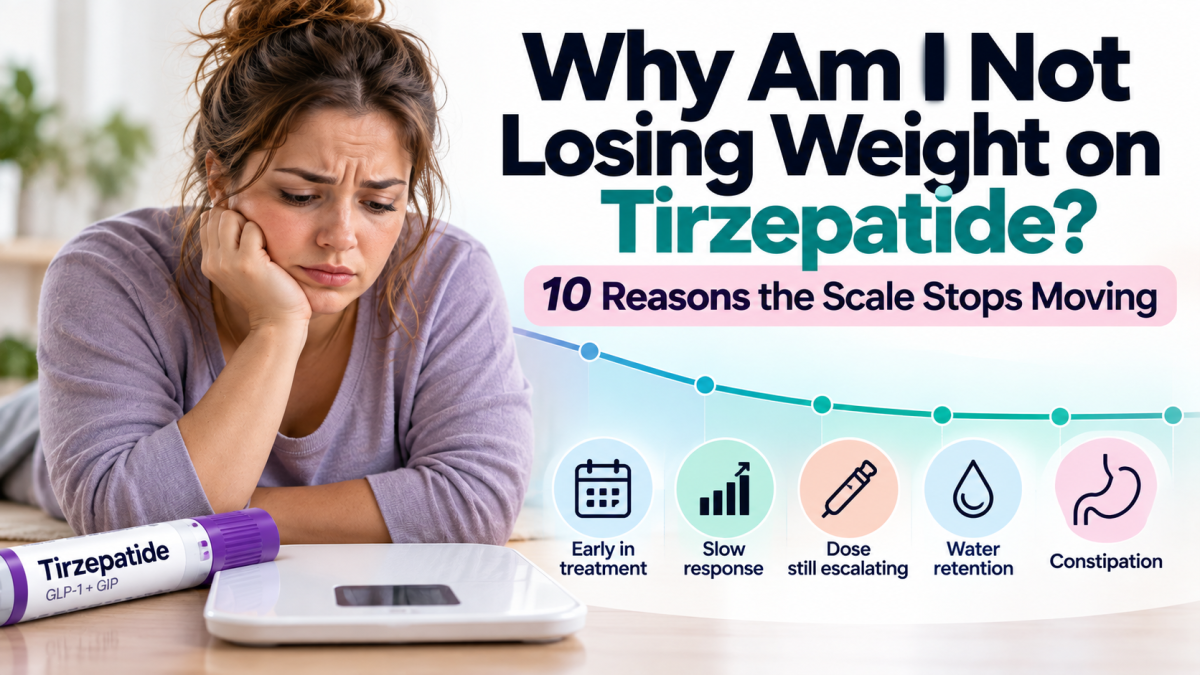
Why Am I Not Losing Weight on Tirzepatide? 10 Reasons the Scale Stops Moving
Why you may not be losing weight on tirzepatide: dose, time on treatment, eating patterns, missed doses, other medicines, and when to talk to your doctor.
Why Am I Not Losing Weight on Tirzepatide? 10 Reasons the Scale Stops Moving
If the scale has stopped moving on tirzepatide, it does not automatically mean the medication has stopped working. Weight loss naturally slows over time, short plateaus are common, and some people respond much later than others.
The important question is not simply, "Why didn't I lose weight this week?" It is whether you are seeing a normal pause, still moving through dose escalation, eating more than you realize, retaining water, losing inches instead of pounds, or dealing with a true longer-term plateau that deserves a closer look.
Related: the tirzepatide dosage guide, best foods to eat on tirzepatide and weight loss by week.
First: A Plateau Is Not the Same as Tirzepatide Failing
Weight loss is rarely a straight line.
You can lose three pounds one week, nothing for two weeks, suddenly drop again, then sit at the same weight for a month. Water, digestion, sodium, menstrual cycles, bowel movements, exercise, and simple day-to-day variation can temporarily hide changes in body fat.
A true plateau is a sustained slowing or stopping of weight reduction over time — not one disappointing weigh-in.
1. You May Simply Be Too Early
The first month of tirzepatide is not designed to show the drug's maximum weight-loss effect.
Treatment usually starts at 2.5 mg once weekly for four weeks. That dose is used to begin treatment and improve tolerability before moving upward. It is not one of the recommended maintenance doses for weight reduction.
So if you are three or four weeks in and wondering why you have not lost 20 pounds yet, the comparison may be unfair. You are still at the beginning of the titration process.
2. You Might Be a Slow Responder
Some people respond quickly. Others do not.
A SURMOUNT-1 analysis looked specifically at people who had lost less than 5% of their body weight after 12 weeks of tirzepatide treatment.
Among those slower early responders, 70% eventually reached at least 5% weight loss by week 24, and 90% reached it by week 72.
That is one of the most useful facts for anyone panicking at month two or three: a slow start does not necessarily predict a poor long-term result.
3. Your Dose May Still Be in the Escalation Phase
Tirzepatide doses are increased gradually, typically in 2.5 mg steps after at least four weeks on the current dose.
For weight reduction, the recommended maintenance doses are 5 mg, 10 mg, or 15 mg once weekly. Dose selection is supposed to consider both treatment response and tolerability.
That does not mean everyone should rush upward. It means somebody who is still early in escalation may not yet have seen their full response.
4. Your Body Now Needs Fewer Calories Than It Did at the Start
This is one of the least exciting explanations, but it matters.
A smaller body generally requires less energy than a larger body. After meaningful weight loss, the calorie intake that once created a large deficit may create a much smaller deficit — or eventually something close to maintenance.
That means the exact same eating pattern can produce rapid loss early and much slower loss later, even though nothing has gone "wrong."
5. Appetite Suppression Can Become Less Dramatic
The first months can feel almost shocking for some people: tiny portions feel satisfying, cravings quiet down, and food stops demanding so much attention.
Later, that effect may feel less intense. Hunger can become more noticeable, meals can become larger, and small extras can quietly return.
That does not necessarily mean tirzepatide has stopped doing anything. The medication may still be helping substantially even if the appetite effect no longer feels as dramatic as it did in week two.
6. Calories Can Creep Back Without Looking Like Much
Weight-loss plateaus are sometimes blamed entirely on metabolism when the explanation is partly behavioral.
Liquid calories, alcohol, restaurant meals, grazing, calorie-dense snacks, larger portions, sauces, and weekend eating can add up surprisingly fast — especially after the dramatic appetite suppression of the early months fades.
The point is not that everyone at a plateau is secretly overeating. It is that small changes matter more once your energy requirements have fallen.
7. Water Weight Can Hide Fat Loss
The scale measures total body weight, not body fat.
A salty meal, constipation, increased carbohydrate intake, menstrual-cycle changes, inflammation after harder exercise, or simply having more food and fluid in the digestive tract can move scale weight by several pounds without representing several pounds of new body fat.
This is why a seven-day trend often tells you more than comparing Tuesday morning with Wednesday morning.
8. Constipation Can Make the Scale Look Stuck
Constipation is common enough with tirzepatide that it deserves its own mention.
Slower gastrointestinal movement and reduced food intake can change bowel patterns. If bowel movements become less frequent, scale weight can temporarily stay higher even while fat loss continues.
Severe or persistent constipation, significant abdominal pain, repeated vomiting, or inability to keep fluids down deserves medical attention rather than simply being treated as a weight-loss inconvenience.
9. Other Medications and Medical Factors Can Affect Weight
Tirzepatide does not operate in isolation.
Other medications, diabetes status, hormonal conditions, sleep, stress, mobility, age, and other medical factors can influence weight and appetite.
Interestingly, a 2026 analysis of several SURMOUNT trials found that people taking medications associated with weight gain were still able to achieve clinically meaningful weight reduction with tirzepatide. So a weight-promoting medication does not automatically cancel tirzepatide — but it can still be relevant to the overall picture.
10. You May Have Reached a Real Biological Plateau
Eventually, weight loss is expected to slow.
A SURMOUNT-1 and SURMOUNT-4 analysis defined a plateau as less than 5% weight change across a 12-week interval followed by similarly small changes afterward.
In SURMOUNT-1, median time to plateau ranged from about 24 weeks in participants with overweight to about 36 weeks in those with class II or III obesity.
By week 72, roughly 88% to 90% of tirzepatide-treated participants in the analysis had reached a plateau across BMI categories.
That is important: reaching a plateau is not unusual. It is eventually the normal destination of successful weight loss.
Higher Doses Were Linked With a Later Plateau
The same analysis found that participants receiving higher tirzepatide doses — 10 mg or 15 mg — tended to reach their weight plateau later than those on lower doses.
That does not mean every plateau should be treated by immediately increasing the dose. The official dosing instructions say maintenance-dose selection should consider both response and tolerability.
A person already at 15 mg has a very different decision from someone still on 5 mg. So does someone losing slowly with no side effects compared with someone vomiting at the current dose.
How Long Should You Wait Before Calling It a Plateau?
A week is not a plateau. Two weeks often is not either.
Researchers studying tirzepatide plateaus used 12-week windows rather than a few days because body weight is noisy. In everyday life, a persistent multi-week or multi-month stall is much more meaningful than a short pause.
The exact point at which to reassess treatment depends on dose, treatment duration, previous weight loss, appetite, side effects, and medical context.
What to Check When the Scale Stops Moving
- 1How long has your weight actually been stable?
- 2Are you looking at a weekly trend or individual weigh-ins?
- 3What tirzepatide dose are you currently taking?
- 4How long have you been on that dose?
- 5Has hunger or food noise noticeably returned?
- 6Have portions, snacks, drinks, or restaurant meals changed?
- 7Are constipation or fluid retention affecting the scale?
- 8Have activity, sleep, stress, or other medications changed?
- 9Are your waist measurements or clothes changing even if weight is not?
- 10Have you already lost enough weight that your calorie needs are now lower?
Should You Increase the Dose?
Sometimes that may be part of the discussion. Sometimes it is completely unnecessary.
The labeled schedule allows increases in 2.5 mg increments after at least four weeks on the current dose, up to 15 mg once weekly. But dose escalation is not meant to be an automatic reaction to every slow week.
If appetite is still well controlled, weight loss has only recently slowed, or side effects are already significant, the answer may not be "more medication."
Should You Eat Less?
Possibly — but "just eat less" is usually too crude to be useful.
A better reassessment is whether portions and calorie-dense extras have gradually increased, whether protein and fiber are adequate, whether meals are satisfying, and whether your current intake still makes sense at your new body weight.
Extreme restriction can backfire by making nutrition, muscle preservation, energy, and long-term adherence worse.
The Scale May Not Be the Best Signal
If body weight is flat, look at what else is changing.
- 1Waist circumference
- 2How clothes fit
- 3Strength and fitness
- 4Blood pressure
- 5Blood sugar measures when relevant
- 6Hunger and portion size
- 7Energy and mobility
- 8Progress over four to twelve weeks rather than four to twelve days
None of these makes the scale irrelevant. They simply stop one number from telling the entire story.
When "Tirzepatide Isn't Working" Deserves a Medical Review
A prolonged lack of response is worth discussing with the clinician managing your treatment, especially if you have had little meaningful weight change despite adequate treatment duration and dose escalation.
It is also worth getting help sooner if severe side effects are preventing you from eating or drinking normally, or if you are considering changing the dose on your own.
The Most Frustrating Truth About Weight Loss
The better tirzepatide works, the closer you eventually get to the point where weight loss slows.
That sounds paradoxical, but every successful weight-loss intervention eventually approaches a new equilibrium. Losing weight forever is not the goal. Reaching a healthier weight and then being able to maintain it is.
So a plateau after substantial weight loss can mean something very different from no response at all.
Low energy often travels with a stalled scale, because both can come from under-eating; the trial numbers, causes and fixes are in does tirzepatide make you tired.
Before deciding the drug is not working, check the normal timeline in how long does it take for Zepbound to work, including what happens to slower responders.
The Bottom Line
If you are not losing weight on tirzepatide, do not judge the medication by one week on the scale.
You may still be early in treatment, still escalating the dose, responding more slowly than average, retaining water, dealing with constipation, eating closer to maintenance than before, or simply reaching the biological plateau that eventually happens with weight loss.
The most reassuring evidence is that slow early response does not equal failure. In SURMOUNT-1, 90% of the people classified as late responders at week 12 eventually lost at least 5% of their starting weight by week 72.
And if you have already lost a substantial amount and the scale has now flattened, that may not be proof the medication stopped working. It may be proof that you are much further into the process than you were when the weight was falling fastest.
Frequently Asked Questions
Common explanations include being early in treatment, still using a lower dose, slower individual response, temporary water retention, constipation, changes in calorie intake, reduced energy needs after previous weight loss, other medications or medical factors, and eventually reaching a normal weight-loss plateau.
Some people lose weight within the first few weeks, while others respond much more slowly. In a SURMOUNT-1 analysis, 90% of participants who had lost less than 5% at week 12 eventually reached at least 5% weight loss by week 72.
Yes. Weight loss eventually slows with successful treatment. In a SURMOUNT analysis, most tirzepatide-treated participants had reached a defined weight plateau by week 72.
There is no fixed duration. Short periods of stable weight may simply reflect normal fluctuations, while a true plateau is more persistent. Research examining tirzepatide plateaus used 12-week weight-change intervals rather than a few days or one week.
Not automatically. Higher doses can produce more weight loss on average, but dose decisions should consider how long you have been on the current dose, appetite control, previous results, side effects, and overall treatment response. Dose changes should be discussed with the clinician managing treatment.
The visible weight-loss effect can slow substantially, especially after significant weight has already been lost. That does not necessarily mean the drug has no ongoing effect on appetite or weight maintenance. A prolonged lack of meaningful response is worth reviewing with a healthcare professional.
Mounjaro contains tirzepatide, so many of the same explanations apply: treatment duration, current dose, individual response, diabetes status, calorie intake, fluid changes, constipation, other medications, and eventual weight plateau can all affect what happens on the scale.
Sources
This article is based primarily on tirzepatide clinical-trial analyses and current prescribing information:
- 1Horn DB, et al. Time to weight plateau with tirzepatide treatment in the SURMOUNT-1 and SURMOUNT-4 clinical trials. Clinical Obesity.
- 2Weight reduction over time in tirzepatide-treated participants by early weight loss response: Post hoc analysis in SURMOUNT-1.
- 3U.S. Food and Drug Administration. Zepbound (tirzepatide) Prescribing Information.
- 4Weight Changes With Tirzepatide and Concomitant Weight-Inducing Medications: Post Hoc Analysis of Randomized Clinical Trials.
Weight-loss response varies substantially between individuals. Do not increase, decrease, stop, or restart tirzepatide solely because of a short-term change on the scale. Written for general education; this page is not medical advice. Tirzepatide.review is independent and is not affiliated with, sponsored by, or endorsed by Eli Lilly and Company.

Nataliia Bondarchuk
Author
Comments (0)
Be the first to comment on this article.
More articles