
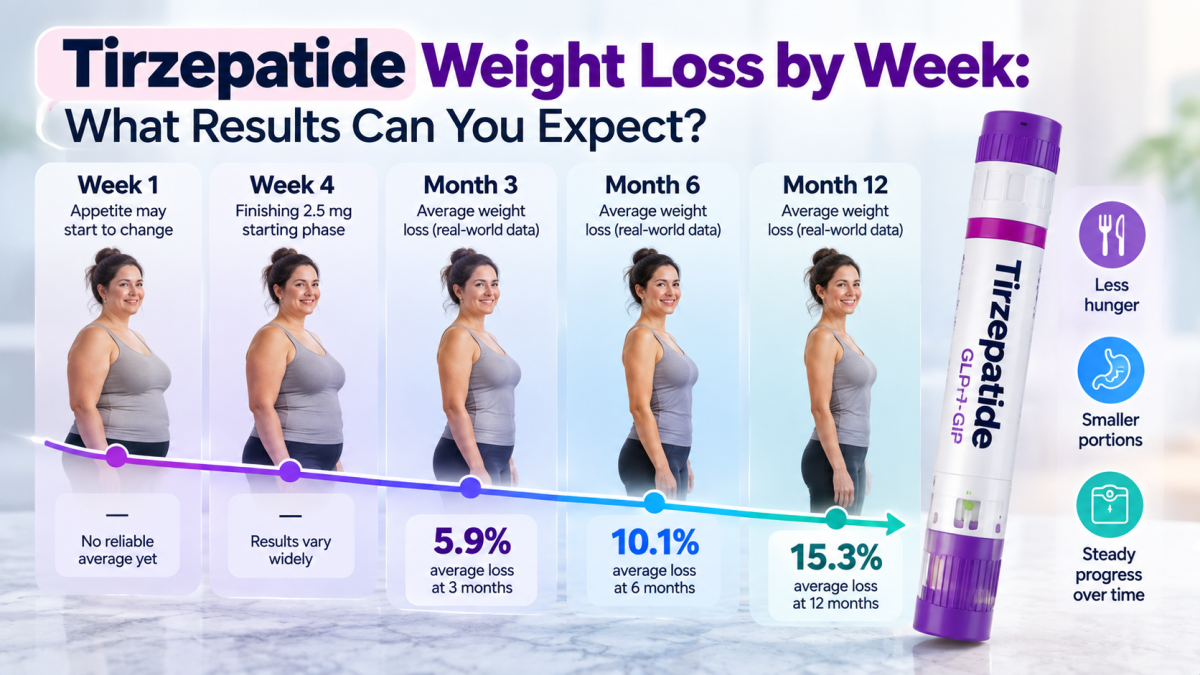
Tirzepatide Weight Loss by Week: What Results Can You Expect?
Tirzepatide weight loss by week and month: what to expect at week 1, week 4 and months 3, 6 and 12, based on clinical trial averages and dose steps.
Tirzepatide Weight Loss by Week: What Results Can You Expect?
Tirzepatide can start changing appetite within the first few weeks, but meaningful weight loss usually builds over months rather than days. In a large real-world study, people still taking tirzepatide had lost an average of about 5.9% of their starting weight at 3 months, 10.1% at 6 months, and 15.3% at 12 months.
The early weeks are much less predictable. Some people see the scale move almost immediately; others notice appetite changes first and lose little during the 2.5 mg starting phase. That is why a useful tirzepatide timeline needs to separate what is actually supported by data from what is simply a common expectation.
Related: before and after results, the dosage guide and why weight loss can stall.
Tirzepatide Weight Loss Timeline at a Glance
- 1Week 1 — appetite or fullness may begin to feel different, but there is no reliable average weight-loss number for one week
- 2Week 4 — you are usually finishing the 2.5 mg starting phase; some people have lost weight, others have barely moved
- 3Month 3 — about 5.9% average weight loss in a large real-world on-treatment analysis
- 4Month 6 — about 10.1% average weight loss in the same real-world analysis
- 5Month 12 — about 15.3% average weight loss among people still receiving tirzepatide in that analysis
Those numbers are population averages, not targets you are supposed to hit. Your result can be substantially faster or slower depending on dose, diabetes status, starting weight, tolerability, treatment interruptions, eating patterns, activity, and individual biology.
Week 1: The Drug Starts Working Before the Scale Tells the Story
The first tirzepatide injection is not supposed to produce a dramatic before-and-after transformation seven days later.
What some people notice first is appetite: smaller meals feel more satisfying, hunger arrives later, cravings feel quieter, or food simply becomes less interesting.
Others notice almost nothing during the first week. Neither experience tells you much about what month six will look like.
How Much Weight Should You Lose in the First Week?
There is no trustworthy universal Week 1 number.
The major obesity trials were designed to evaluate weight loss across many months, not to give people a seven-day benchmark. Early scale changes are also heavily influenced by water, food intake, bowel contents, sodium, and normal day-to-day fluctuation.
A person who loses four pounds in Week 1 has not necessarily started 'better' than someone who loses one pound or nothing at all.
Weeks 2–4: Still the Starting Phase
For Zepbound, the recommended starting dosage is 2.5 mg once weekly for the first four weeks.
That matters because 2.5 mg is an initiation dose. It is not one of the recommended maintenance doses for long-term weight reduction.
So Month 1 is better understood as your body's introduction to tirzepatide than as a final test of how strongly you respond.
Week 4: Why the First Month Can Be Misleading
By the end of Week 4, some people have already seen a noticeable drop on the scale. Others have seen only a small change.
There is no high-quality trial benchmark saying that everyone should have lost a particular percentage by Week 4. The official dosing schedule itself is a reminder of why: most people are still only finishing the introductory dose.
After four weeks, treatment usually moves to 5 mg once weekly. Further increases can occur in 2.5 mg steps after at least four weeks on the current dose, depending on response and tolerability.
Month 2: The Dose Is Rising, but Your Result May Still Look Small
Month 2 is often when people start comparing themselves with dramatic social-media transformations.
That comparison can be brutal because the person in the video may be showing six or twelve months of treatment while you are still eight weeks in.
At this stage, what matters more is the direction of travel: appetite, portion size, weekly weight trend, tolerability, and whether treatment is progressing as planned.
Month 3: This Is Where the Numbers Become More Useful
At three months, we finally have a stronger real-world benchmark.
In a large U.S. comparative effectiveness study, people receiving tirzepatide who remained on treatment had lost an average of 5.9% of their starting body weight at three months.
At a starting weight of 200 pounds, 5.9% is about 11.8 pounds. At 250 pounds, it is about 14.8 pounds. At 300 pounds, it is about 17.7 pounds.
What If You Have Lost Less Than 5% at 12 Weeks?
That does not automatically mean tirzepatide has failed.
A later SURMOUNT-1 analysis classified participants who had lost less than 5% by Week 12 as late responders. They made up about 18% of the analyzed tirzepatide group.
Of those late responders, 70% eventually reached at least 5% weight loss by Week 24, and 90% reached it by Week 72.
That is one of the clearest arguments against deciding at Week 12 that you are a non-responder.
Month 6: The Difference Becomes Much Easier to See
At six months, average on-treatment weight loss in the same real-world study reached about 10.1%.
That is roughly 20 pounds from a 200-pound starting weight, 25 pounds from 250 pounds, or 30 pounds from 300 pounds.
Six months is also a very different treatment stage from six weeks. Depending on the individual dose plan, titration may be much further along and there has been considerably more time for cumulative weight loss.
Month 12: Real-World Weight Loss Can Become Substantial
At twelve months, average on-treatment weight loss in the large real-world analysis was 15.3%.
For someone starting at 200 pounds, that is about 30.6 pounds. At 250 pounds, it is about 38.3 pounds. At 300 pounds, it is about 45.9 pounds.
But twelve months is not necessarily the end of weight loss. The major SURMOUNT-1 obesity trial continued to 72 weeks, and average weight loss at that point reached 15.0% with 5 mg, 19.5% with 10 mg, and 20.9% with 15 mg.
A Tirzepatide Weight Loss Chart Should Not Look Like a Straight Line
Real weight loss does not happen as a perfectly smooth downward slope.
There may be faster periods, flat weeks, sudden drops, constipation-related stalls, holiday weeks, dose changes, illness, travel, menstrual-cycle changes, and normal water fluctuations.
The useful chart is therefore a long-term trend, not a promise that every week should end lower than the week before.
How Fast Does Tirzepatide Work?
If by 'work' you mean appetite effects, some people notice a change during the first days or weeks.
If you mean clinically meaningful weight loss, that usually requires more time. The strongest evidence is measured in months, not in what happens after the first injection.
Why Two People Can Be on the Same Week and Have Completely Different Results
- 1They may be taking different doses
- 2One may have type 2 diabetes and the other may not
- 3Starting body weight may be very different
- 4One may have had treatment interruptions
- 5Appetite response can differ dramatically
- 6Side effects may limit food intake or dose escalation
- 7Activity and eating patterns differ
- 8Other medications can affect body weight
- 9Individual biology and genetics matter
That is why 'I lost 12 pounds by Week 4' is an anecdote, not a treatment benchmark.
People With Type 2 Diabetes Often Lose Weight More Slowly
Across tirzepatide research, people with type 2 diabetes often show smaller average weight reductions than comparable groups without diabetes.
The real-world study that reported 3-, 6-, and 12-month outcomes also found larger reductions among people without type 2 diabetes than among those with diabetes.
That means copying somebody else's weekly chart can be especially misleading when the medical context is different.
Should You Worry If the Scale Does Not Move Every Week?
Usually, no.
A week or two of stable weight can reflect water retention, constipation, increased exercise, sodium intake, hormonal changes, or normal statistical noise.
Longer trends matter more. A sustained plateau over many weeks is a different question from an unchanged number after seven days.
When Does Weight Loss Usually Slow Down?
Eventually, almost everyone stops losing weight at the same speed.
A SURMOUNT analysis found that median time to a defined weight plateau was roughly 24 to 36 weeks depending on baseline BMI category, although many participants continued losing beyond that point before fully stabilizing.
So a curve that becomes flatter later in treatment is not necessarily evidence that tirzepatide has suddenly failed.
What Is a Good Tirzepatide Result at 3, 6, and 12 Months?
There is no single pass-or-fail number.
The real-world averages of roughly 5.9%, 10.1%, and 15.3% at 3, 6, and 12 months are useful orientation points. They are not deadlines.
A person below the average can still be having a clinically meaningful response. A person above it is not guaranteed to keep losing at the same speed.
The Most Useful Way to Track Progress
- 1Use consistent weigh-in conditions
- 2Focus on weekly averages rather than one reading
- 3Compare month-to-month trends
- 4Track waist circumference as well as weight
- 5Notice appetite and portion changes
- 6Record major dose changes
- 7Pay attention to strength and how clothes fit
- 8Do not let somebody else's Week 4 become your personal deadline
Losing weight at the pace in these tables has a side effect that shows up months later: temporary hair shedding, reported by about 5% of trial participants. Our guide to tirzepatide and hair loss gives the timeline, the trial numbers and how to limit it without slowing your results.
When the drug starts acting in the body, and when most people see their first 5%, is set out in how long does it take for Zepbound to work.
If you are on the second step of the schedule, see tirzepatide 5 mg: what to expect for trial results, side effects and cost at that dose.
The Bottom Line
Tirzepatide can begin affecting appetite early, but the strongest weight-loss results build over time.
Do not expect a scientifically precise Week 1 or Week 4 target. The first month is still the 2.5 mg starting phase, and individual early responses vary enormously.
For a more useful reality check, large real-world data show average on-treatment weight loss of about 5.9% at 3 months, 10.1% at 6 months, and 15.3% at 12 months. Clinical trials show that loss can continue well beyond a year.
The most important chart is not somebody else's perfect downward line. It is whether your own trend is moving in the right direction over enough time to mean something.
Frequently Asked Questions
There is no reliable universal first-month percentage. The first four weeks are usually spent on the 2.5 mg initiation dose, and early weight changes vary widely. Some people lose noticeable weight while others see only small changes before later dose escalation.
In a large real-world study, people still receiving tirzepatide had lost an average of about 5.9% of their starting body weight at three months. Individual results can be much higher or lower.
The same large real-world analysis reported average on-treatment weight loss of about 10.1% at six months.
Average on-treatment weight loss was about 15.3% at 12 months in a large U.S. real-world study. Longer obesity trials have reported still greater average losses at later time points and higher maintenance doses.
Some people notice reduced hunger or increased fullness during the first few weeks. Meaningful weight reduction typically develops progressively over months, and a slow early response does not necessarily predict a poor long-term result.
It can happen. The first month is generally the 2.5 mg initiation phase, and response varies. A lack of dramatic early weight loss does not by itself establish that tirzepatide will not work later.
That does not automatically mean treatment has failed. In a SURMOUNT-1 analysis, 70% of participants classified as late responders at Week 12 reached at least 5% weight loss by Week 24, and 90% did so by Week 72.
Sources
This article uses real-world weight-loss data, SURMOUNT trial evidence, and current U.S. prescribing information:
- 1Rodriguez PJ, et al. Semaglutide vs Tirzepatide for Weight Loss in Adults With Overweight or Obesity. JAMA Internal Medicine.
- 2Jastreboff AM, et al. Tirzepatide Once Weekly for the Treatment of Obesity. New England Journal of Medicine.
- 3Ard J, et al. Weight reduction over time in tirzepatide-treated participants by early weight loss response: Post hoc analysis in SURMOUNT-1.
- 4U.S. Food and Drug Administration. Zepbound (tirzepatide) Prescribing Information.
Weight-loss timelines vary substantially between individuals. Early weekly changes should not be used on their own to change a tirzepatide dose or judge whether treatment has failed. Written for general education; this page is not medical advice. Tirzepatide.review is independent and is not affiliated with, sponsored by, or endorsed by Eli Lilly and Company.

Nataliia Bondarchuk
Author
Comments (0)
Be the first to comment on this article.
More articles