Is Tirzepatide a Peptide? The 39-Amino-Acid "Twincretin" Explained
Yes: tirzepatide is a 39-amino-acid peptide built on GIP that also activates GLP-1. How it is made, why it lasts a week, and how it differs from online peptides
Written by Nataliia Bondarchuk. Updated October 25, 2026.
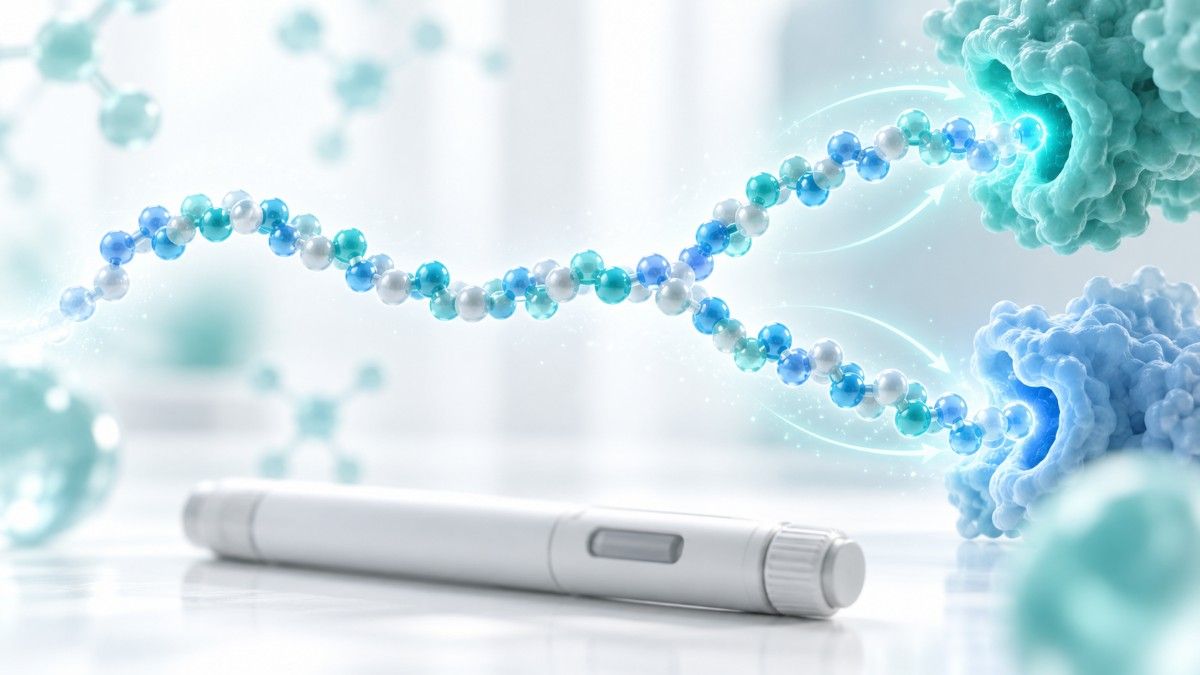
Yes, tirzepatide is a peptide: a single chain of 39 amino acids that activates two gut-hormone receptors at once, GLP-1 and GIP, which is why it is called a dual agonist or "twincretin." Its backbone is based on the hormone GIP rather than GLP-1, with changes that let it also fit the GLP-1 receptor, and a 20-carbon fatty acid that binds to albumin so one injection lasts a week. At 39 amino acids it falls just under FDA's 40-amino-acid line between peptide drugs and biologics, which has practical consequences for how Zepbound and Mounjaro are made, copied and compounded.
This guide explains what a peptide is, how tirzepatide's structure produces its unusual two-hormone effect, how it compares with semaglutide and with the "peptides" sold online, and what being a peptide means for injections, storage, the coming pill, compounding and price.
Is Tirzepatide a Peptide? The Short Answer
- 1Yes. Tirzepatide (Zepbound, Mounjaro) is a synthetic 39-amino-acid peptide, molecular weight about 4,800 daltons.
- 2It is built on the GIP hormone sequence, engineered so that it also activates the GLP-1 receptor: one molecule, two receptors.
- 3A C20 fatty diacid attached at position 20 binds albumin, giving a half-life of about 5 days and once-weekly dosing.
- 4Two non-standard amino acids (Aib at positions 2 and 13) protect it from the enzyme DPP-4.
- 5Regulated as a peptide drug (NDA, future generics), not a biologic; U.S. patents run to the mid-2030s.
- 6It is not "peptide therapy": tirzepatide is FDA-approved for type 2 diabetes, weight management and sleep apnea after trials in more than 20,000 people.
What Counts as a Peptide
A peptide is a short chain of amino acids linked by peptide bonds. Chemists generally call chains of up to about 50 amino acids peptides and longer chains proteins; FDA uses a hard cutoff of 40 for regulation, calling anything longer a protein and therefore a biologic. Many of the body's hormones are peptides: insulin (51 amino acids, at the border), GLP-1 (30 to 31), GIP (42), glucagon (29). Tirzepatide's 39 amino acids make it a peptide by both the chemist's and the regulator's definitions, three amino acids shorter than the GIP hormone it is modeled on.
How Tirzepatide Is Built
GIP, GLP-1 and tirzepatide compared
Length
42 amino acids
30 to 31 amino acids
39 amino acids
Receptors activated
GIP receptor
GLP-1 receptor
Both; stronger at GIP than GLP-1
Protection from DPP-4
None; cut within minutes
None; cut within minutes
Aib at positions 2 and 13
Albumin binding
No
No
C20 fatty diacid at lysine 20 via a linker
Half-life
Minutes
About 2 minutes
About 5 days (117 hours)
Made by
Intestinal K-cells
Intestinal L-cells
Chemical synthesis (solid-phase), then purification
Lilly's chemists started with GIP, which binds its own receptor tightly, and swapped in amino acids from GLP-1 and from exenatide at key positions until the molecule also activated the GLP-1 receptor well. The result is an "imbalanced" dual agonist: it is roughly as potent as natural GIP at the GIP receptor but about five times weaker than natural GLP-1 at the GLP-1 receptor, a balance that turned out to give more weight loss with less nausea than a pure GLP-1 drug at matched doses. Unlike semaglutide, whose backbone is grown in yeast, tirzepatide is made entirely by chemical peptide synthesis.
Why Two Receptors Matter
GLP-1 receptor activation lowers appetite, slows the stomach and boosts insulin when sugar is high. GIP receptor activation adds appetite suppression through a different brain pathway, improves how fat tissue stores and releases energy, and appears to blunt the nausea that GLP-1 causes, which lets the dose go higher. The combination is why tirzepatide produced 20.9% weight loss at 15 mg in SURMOUNT-1 versus about 15% for semaglutide 2.4 mg in its own trial, and 20.2% versus 13.7% head to head in SURMOUNT-5. The mechanism is explained in how Zepbound works and the comparison in tirzepatide vs semaglutide.
Peptide, Small Molecule or Biologic?
Where tirzepatide sits
Size
Under about 1,000 daltons
About 4,800 daltons (tirzepatide); 39 amino acids
More than 40 amino acids
Manufacturing
Chemical synthesis
Chemical synthesis (tirzepatide) or fermentation plus chemistry (semaglutide)
Living cells
Oral?
Usually yes
No for tirzepatide today; an oral small-molecule successor (orforglipron) is in development
No
Approval route
NDA
NDA
BLA
Copies after patent
Generics
Generics that must match the peptide exactly
Biosimilars
Compounding
Allowed under rules
Allowed only during an FDA-declared shortage; the tirzepatide shortage ended in December 2024
Generally not
Why Tirzepatide Is Injected
Peptides are exactly what the stomach and small intestine are built to digest, and a 4,800-dalton molecule cannot cross the gut wall on its own. A weekly injection under the skin avoids both problems. Lilly's answer to the pill question is not an oral tirzepatide but orforglipron, a small molecule that activates the GLP-1 receptor and can be swallowed; it does not touch the GIP receptor. See tirzepatide pill for where that stands. Within the injectable options, the drug is the same in the single-dose pen, the self-pay vials and the four-dose Zepbound KwikPen.
Tirzepatide vs "Research Peptides"
Sellers of unapproved peptides often list tirzepatide alongside BPC-157, CJC-1295 and ipamorelin as if they were the same kind of product. The chemistry is similar; nothing else is:
- 1Evidence: tirzepatide's SURPASS and SURMOUNT programs enrolled more than 20,000 people across randomized trials up to 176 weeks. Most research peptides have no controlled human trials.
- 2Approval: Mounjaro (type 2 diabetes, 2022), Zepbound (weight management, 2023; obstructive sleep apnea, 2024). Research peptides are approved for nothing.
- 3Quality: brand tirzepatide is made and tested to pharmaceutical standards. Vials sold online as "tirzepatide" or "GLP-2 peptide" are unverified, and FDA warning letters in 2026 named sellers marketing them with research-use disclaimers.
- 4The mislabel "GLP-2": some sellers call tirzepatide "GLP-2." GLP-2 is a real, unrelated gut hormone (teduglutide is a GLP-2 drug for short bowel syndrome). Tirzepatide is a GIP/GLP-1 agonist.
What Being a Peptide Means for You
- 1Weekly dosing and a gradual fade: a missed dose wears off over days, not hours, which is why the label allows a late dose within 4 days.
- 2Storage: heat and freezing damage peptides. Refrigerate; unopened pens can stay at room temperature up to 21 days, an in-use KwikPen up to 30 days.
- 3Compounding is over: during the 2022 to 2024 shortage compounders could legally make tirzepatide; FDA declared the shortage resolved in December 2024 and the grace periods ended in early 2025. Compounded tirzepatide now is outside the law for mass production.
- 4No generic soon: patents run into the mid-2030s, and an exact peptide copy is demanding to manufacture. Self-pay pricing through LillyDirect ($299 to $449 a month) is the current route around list price.
- 5Immune reactions are rare: about half of trial participants developed antibodies, but these did not reduce effect or cause harm in the vast majority.
What Tirzepatide Does Once It Is In
Structure explains how long it lasts; receptors explain what it does. Through GLP-1 and GIP receptors tirzepatide cuts hunger and cravings, slows gastric emptying, raises insulin when glucose is high and improves fat metabolism, producing 15% to 21% weight loss across the maintenance doses and large A1C reductions in diabetes. The dose ladder is in tirzepatide dosage for weight loss; the two brand names are compared in Mounjaro vs Zepbound.
When to Talk to Your Doctor
- 1If you have been offered "tirzepatide" by a source other than a licensed pharmacy dispensing Zepbound or Mounjaro
- 2If you have a personal or family history of medullary thyroid cancer or MEN 2, pancreatitis or severe gastrointestinal disease
- 3If you take insulin or sulfonylureas, which need adjusting with any incretin peptide
- 4If you are considering waiting for an oral option rather than starting injections
If the brand names are confusing, see is Wegovy tirzepatide? Brand names explained for a side-by-side list of tirzepatide and semaglutide brands.
The Bottom Line
Tirzepatide is a 39-amino-acid peptide engineered from the GIP hormone to activate both the GIP and GLP-1 receptors, with a fatty acid that keeps it in the blood for a week. Being a peptide is why it is injected, refrigerated, regulated as a drug rather than a biologic, and briefly compounded during a shortage. It is also the only thing it has in common with the unapproved "peptides" sold online. For what comes after dual agonists, including the triple agonist retatrutide, see what comes after tirzepatide; for the side effects that follow from its receptors, see our side effects page.
FAQ
Yes. Tirzepatide is a synthetic 39-amino-acid peptide based on the gut hormone GIP, modified to also activate the GLP-1 receptor and to last about five days in the blood. It is regulated as a peptide drug, not a biologic.
Both. It is a dual GIP and GLP-1 receptor agonist, sometimes called a twincretin. Its backbone is closer to GIP, and it is somewhat stronger at the GIP receptor than at the GLP-1 receptor.
Thirty-nine amino acids, including two non-natural Aib residues that block enzyme breakdown, plus a 20-carbon fatty diacid attached at position 20 that binds albumin. It is made by chemical peptide synthesis.
No. Tirzepatide is an FDA-approved medicine with trials in over 20,000 people. "Peptide therapy" products sold online are unapproved, untested in controlled trials and not made to pharmaceutical standards.
Because it mimics two incretin hormones, GIP and GLP-1, in one molecule. Incretins are gut hormones released after eating that boost insulin and reduce appetite.
Sources
- 1LY3298176, a novel dual GIP and GLP-1 receptor agonist for the treatment of type 2 diabetes mellitus: From discovery to clinical proof of concept, Mol Metab, 2018
- 2Tirzepatide, a New Era of Dual-Targeted Treatment for Diabetes and Obesity: A Mini-Review, Molecules, 2022
- 3Zepbound (tirzepatide) prescribing information, DailyMed
- 4Tirzepatide Once Weekly for the Treatment of Obesity (SURMOUNT-1), NEJM, 2022
- 5Tirzepatide as Compared with Semaglutide for the Treatment of Obesity (SURMOUNT-5), NEJM, 2025
- 6Definition of the Term "Biological Product": final rule (40 amino acid threshold), Federal Register, February 2020
- 7FDA clarifies policies for compounders as national GLP-1 supply begins to stabilize, U.S. FDA
- 8Warning Letter: Gram Peptides, U.S. FDA, March 2026
This article is for general information and is not medical advice.

Nataliia Bondarchuk
Author
Comments (0)
Be the first to comment on this article.
More articles