
What Happens When You Stop Tirzepatide? The Truth About Weight Regain
What happens when you stop tirzepatide: how fast appetite returns, how much weight trials show is regained, and how to stop more safely with your doctor.
What Happens When You Stop Tirzepatide? The Truth About Weight Regain
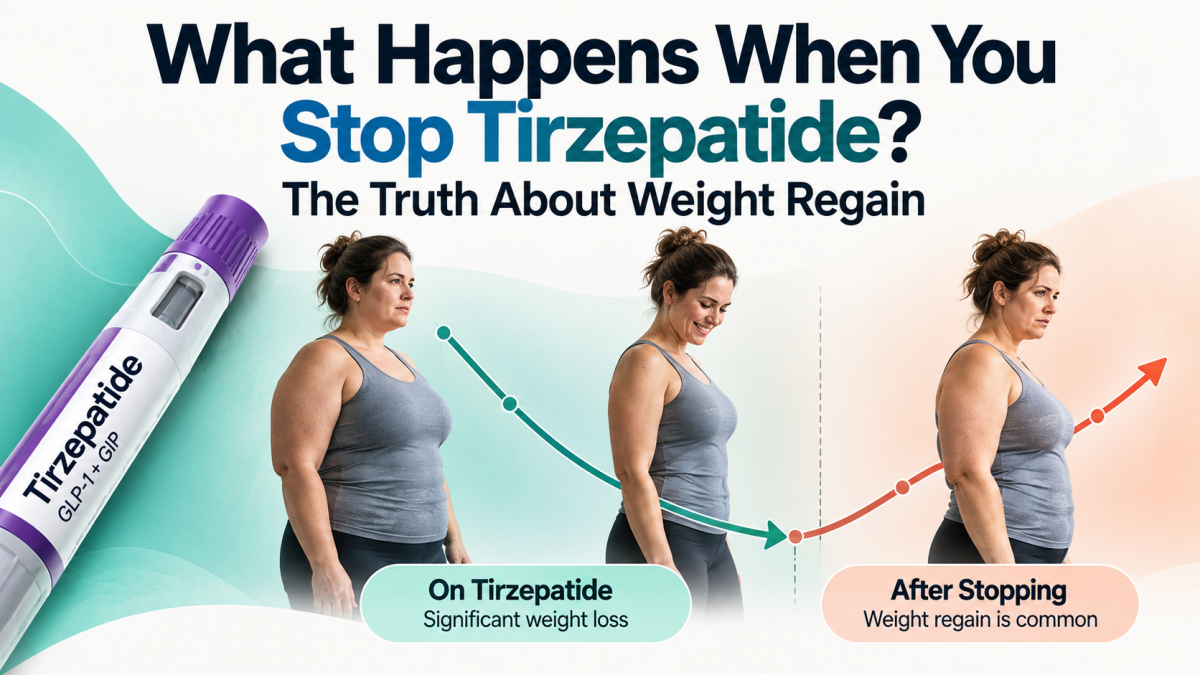
Stopping tirzepatide often leads to weight regain. In SURMOUNT-4, people first lost an average of 20.9% of their body weight during 36 weeks of tirzepatide treatment. Those who were then switched to placebo regained an average of 14.0% of their weight over the following year, while people who stayed on tirzepatide lost another 5.5%.
The important part is what that means in real life: tirzepatide does not permanently switch off hunger or permanently reset the biology that helped drive weight gain in the first place. When the medication leaves the body, appetite can return, fullness can feel less powerful, and maintaining the same weight can become much harder.
Related: tirzepatide and muscle loss, weight loss by week and the dosage guide.
SURMOUNT-4 Was Basically a Real-World Fear Put Into a Trial
The question was brutally simple: what happens after people lose a lot of weight on tirzepatide and then stop?
Everyone in SURMOUNT-4 started with tirzepatide. For 36 weeks, doses were gradually increased and participants lost an average of 20.9% of their starting body weight.
Then the trial split them in two. One group kept taking tirzepatide. The other was switched to placebo without knowing which treatment they were receiving.
That is where the two weight curves started moving in opposite directions.
People Who Continued Tirzepatide Kept Losing Weight
Over the next 52 weeks, the group that stayed on tirzepatide lost another 5.5% of body weight on average.
By the end of the full 88-week study, their total average weight reduction from the beginning of treatment was about 25%.
In other words, reaching a large weight loss did not mean the medication had finished its job. Continued treatment was doing something important: helping hold that new biological state in place.
People Who Stopped Regained a Significant Amount
The placebo group moved the other way.
After tirzepatide was withdrawn, participants gained an average of 14.0% from their week-36 weight over the next year.
They did not instantly return to their exact starting weight. But a substantial portion of the weight they had worked to lose came back.
Only 16.6% of participants who stopped tirzepatide maintained at least 80% of the weight they had initially lost. Among those who continued treatment, 89.5% did.
The 2026 Follow-Up Makes the Regain Look Even More Real
A later analysis of SURMOUNT-4 looked more closely at exactly how much of the lost weight people regained after tirzepatide withdrawal.
Among 308 participants included in that analysis, 82.5% regained at least one quarter of the weight they had previously lost within one year of stopping tirzepatide.
Nearly one quarter of participants regained at least 75% of their original weight loss.
That is a very different picture from the idea that you simply take tirzepatide until you reach your goal weight and then walk away with the result permanently locked in.
Why Does the Weight Come Back?
Because the medication was actively changing the system that controls appetite, fullness, blood sugar, and energy balance.
While tirzepatide is active, many people feel less hungry, get full sooner, think about food less often, and naturally eat less. Those effects are part of why weight loss becomes possible.
When the medication is removed, the biology that existed before treatment has not necessarily disappeared. Hunger signals can strengthen again. Portions that once felt enormous may start feeling normal. Cravings can become more noticeable. Maintaining the calorie intake that produced weight loss can suddenly require much more effort.
The Hunger Coming Back Can Be the Most Shocking Part
People sometimes focus so much on the scale that they miss what the medication was doing in the background.
Imagine spending a year rarely thinking about snacks, feeling satisfied after smaller meals, and discovering that food suddenly occupies much less mental space. Then those old signals start creeping back.
That can feel like losing willpower. Biologically, it may be closer to losing one of the tools that was making weight maintenance easier.
How Quickly Does Weight Come Back?
Usually not overnight.
A 2026 systematic review examining weight regain after stopping GLP-1-based medications found a consistent rebound pattern. Across randomized trials, participants regained about 60% of the weight they had lost within one year after treatment ended.
The regain was fastest earlier after stopping and then slowed over time. That makes intuitive sense: as body weight rises again, the biological and energy-balance pressures driving further regain may gradually become less intense.
The same analysis estimated that some weight-loss benefit may remain long term, but much of the original loss is at risk of being erased when medication is discontinued.
The Scale Isn't the Only Thing That Can Move Backward
SURMOUNT-4 did not only track pounds.
During the initial tirzepatide treatment period, participants improved blood pressure, blood sugar, insulin-related measures, cholesterol, triglycerides, and waist circumference.
When people regained weight after stopping tirzepatide, many of those improvements began moving back toward baseline too.
The more weight participants regained, the greater the reversal tended to be.
So Is Tirzepatide Supposed to Be a Lifelong Medication?
For many people, obesity treatment is increasingly being approached as long-term treatment rather than a short course with a clean finish line.
That does not mean every person who starts tirzepatide must automatically take it forever. It means the evidence does not support pretending that the medication's effects necessarily remain after the medication is gone.
The better question is often not "When can I finally stop?" but "What is the long-term plan for maintaining the benefit?"
What Is a Tirzepatide Maintenance Dose?
A maintenance dose is the dose used on an ongoing basis after dose escalation, rather than a special low dose that automatically comes after someone reaches a goal weight.
For Zepbound, approved maintenance doses depend on the indication and include specific weekly dose options. The right maintenance dose is based on treatment response and tolerability, not simply on hitting a particular number on the scale.
There is currently no universal evidence-based rule saying that everyone who reaches their target weight should drop to the smallest possible dose.
Does a Lower Maintenance Dose Prevent Regain?
This is one of the questions people care about most — and one where the evidence is less satisfying than the internet makes it sound.
SURMOUNT-4 tested continued treatment at the maximum tolerated dose, which was 10 mg or 15 mg, versus complete withdrawal. It did not test every imaginable lower-dose maintenance strategy.
So the trial gives us strong evidence that continuing treatment works much better than stopping completely. It does not prove what the ideal minimum maintenance dose is for every individual.
Can You Stop Tirzepatide Slowly Instead?
People often assume tapering must prevent rebound because tapering is important with some other medications.
But tirzepatide does not have an established withdrawal syndrome that requires tapering in the way certain steroids, antidepressants, or sedatives may.
The bigger issue is what happens after the drug effect fades. Whether gradually lowering the dose materially reduces long-term weight regain has not been established well enough to treat tapering as a proven solution.
Can Diet and Exercise Stop the Weight From Coming Back?
They matter. But they do not magically erase the biology.
Participants in SURMOUNT-4 continued lifestyle intervention even after tirzepatide was withdrawn, yet substantial regain still occurred.
That is an important detail because it pushes back against the idea that weight regain after stopping must mean somebody went back to "bad habits." Lifestyle remains important, but it may be fighting stronger appetite and metabolic signals once pharmacologic support disappears.
Does Everyone Regain All the Weight?
No.
The average trend is clear, but individuals vary enormously. Some people regain relatively little. Others regain most of what they lost.
The 2026 SURMOUNT-4 analysis is useful here: 17.5% of participants who stopped regained less than one quarter of their previous weight loss. That is a minority, but it proves that rebound is not identical for everyone.
What If You Have to Stop Because of Cost or Side Effects?
This is where the tidy clinical-trial discussion collides with real life.
People stop medication because insurance changes, prices become unaffordable, side effects become too difficult, supply becomes unreliable, pregnancy is being considered, surgery is coming up, or treatment simply no longer feels worth it.
If stopping is necessary, knowing that regain is common makes planning more useful than treating rebound as an unexpected failure. A clinician may be able to discuss alternative medications, nutrition support, activity, monitoring, or another long-term strategy.
What If You Restart Tirzepatide After Regaining Weight?
Restarting may be considered in some situations, but it should not be treated as simply picking up exactly where you left off.
After time away from treatment, tolerability may have changed and restarting at a previous high dose can create significant gastrointestinal side effects. The appropriate restart plan depends on how long treatment was interrupted and the person's medical situation.
The Psychological Part of Regain Deserves More Attention
Watching weight return after a major loss can feel brutal.
Someone may spend a year watching the number move down, buying smaller clothes, getting compliments, and feeling that an old struggle has finally become manageable. Seeing the scale reverse can feel like all of that progress is being taken away.
The trial data offer an important perspective: regain after withdrawal is common enough to be considered part of the biology of treatment discontinuation, not evidence that one person uniquely failed.
The Question May Be Wrong
People often ask, "How do I keep the weight off after tirzepatide?"
SURMOUNT-4 suggests a more uncomfortable question: if the treatment is controlling a chronic biological condition, why should we assume stopping the treatment will preserve its full effect?
We do not usually expect blood pressure to stay controlled forever after removing a blood-pressure medication. Obesity treatment may increasingly need to be thought about through a similar long-term lens.
The Bottom Line
Stopping tirzepatide does not guarantee that all the weight will return. But the best evidence we have says substantial regain is common.
In SURMOUNT-4, participants who stopped tirzepatide regained significant weight over the following year, while those who continued treatment maintained most of their previous loss and lost additional weight. A 2026 follow-up found that more than 8 in 10 people who stopped regained at least 25% of the weight they had initially lost.
The real lesson is not that tirzepatide "doesn't work" because weight comes back after stopping. It may be almost the opposite: the rebound shows how much work the medication was doing while it was there.
Frequently Asked Questions
Many people do. In SURMOUNT-4, participants who were switched from tirzepatide to placebo regained an average of 14.0% of their week-36 body weight over the following 52 weeks, while those who continued tirzepatide lost another 5.5%.
No. Regain varies widely. A 2026 SURMOUNT-4 analysis found that 82.5% of participants who stopped regained at least 25% of their previous weight loss within one year, meaning a minority regained less than that.
Weight regain usually develops over months rather than appearing all at once. A 2026 systematic review of GLP-1-based medications estimated that roughly 60% of previously lost weight was regained within one year after treatment cessation.
It can. Tirzepatide reduces appetite and increases fullness while it is active. As the medication leaves the body, those effects can weaken and hunger or food cravings may become more noticeable again.
Long-term treatment may be appropriate for many people, but the correct maintenance dose is individual. SURMOUNT-4 strongly supports continued treatment over complete withdrawal, but it did not determine the lowest effective maintenance dose for every person.
There is not yet strong evidence that tapering prevents long-term weight regain. Tirzepatide does not have a known withdrawal syndrome requiring a taper, and the main challenge after stopping is the loss of its appetite and metabolic effects.
They can support weight maintenance, but they may not fully prevent regain. In SURMOUNT-4, participants continued lifestyle intervention after tirzepatide withdrawal and still regained significant weight on average.
Sources
This article is based primarily on randomized withdrawal evidence from SURMOUNT-4 and newer analyses of weight regain after discontinuing incretin-based treatment:
- 1Aronne LJ, et al. Continued Treatment With Tirzepatide for Maintenance of Weight Reduction in Adults With Obesity: The SURMOUNT-4 Randomized Clinical Trial. JAMA.
- 2Horn DB, et al. Cardiometabolic Parameter Change by Weight Regain on Tirzepatide Withdrawal in Adults With Obesity: A Post Hoc Analysis of the SURMOUNT-4 Trial. JAMA Internal Medicine.
- 3Budini B, et al. Trajectory of weight regain after cessation of GLP-1 receptor agonists: a systematic review and nonlinear meta-regression. EClinicalMedicine. 2026.
Weight regain after treatment discontinuation varies between individuals. Decisions about continuing, reducing, stopping, or restarting tirzepatide should be made with a qualified healthcare professional. Written for general education; this page is not medical advice. Tirzepatide.review is independent and is not affiliated with, sponsored by, or endorsed by Eli Lilly and Company.

Nataliia Bondarchuk
Author
Comments (0)
Be the first to comment on this article.
More articles