Tirzepatide Face, Loose Skin and Body Changes After Rapid Weight Loss
Can tirzepatide change your face or cause loose skin? Why rapid weight loss causes facial hollowing and skin laxity, and what may help.
Tirzepatide Face, Loose Skin and Body Changes After Rapid Weight Loss
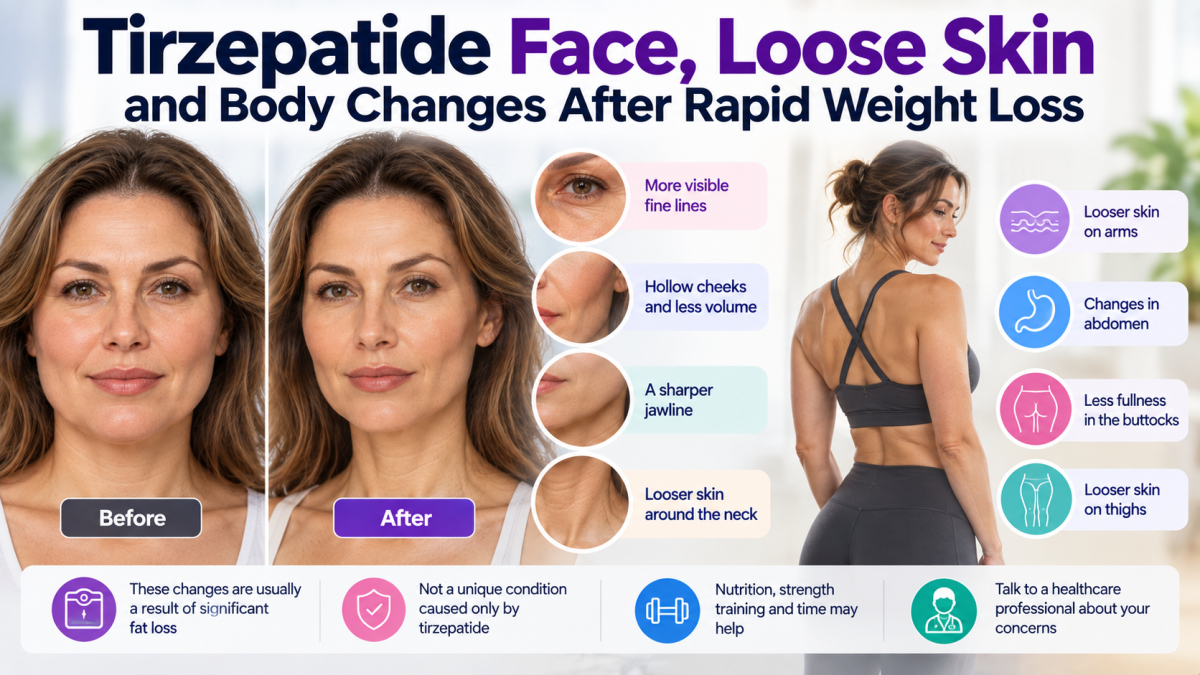
Yes, tirzepatide can be followed by noticeable changes in the face and body — especially after large or rapid weight loss. People may notice hollow cheeks, a sharper jawline, looser skin, more visible wrinkles, changes in the neck, breasts, abdomen, arms, or thighs, and an overall appearance that feels very different from simply becoming "smaller."
But there is no special disease called "tirzepatide face." Much of what gets labeled "Ozempic face" or "GLP-1 face" reflects loss of facial fat and changes in skin support that can happen after substantial weight loss from many causes. Tirzepatide can make that conversation more visible because it can produce unusually large reductions in body weight.
What Does “Tirzepatide Face” Actually Look Like?
The phrase usually describes a collection of cosmetic changes rather than one medically defined condition.
- 1Less fullness in the cheeks or temples
- 2More visible cheekbones
- 3A more hollow appearance under the eyes
- 4Deeper facial folds or lines
- 5Loose or crepey skin
- 6A sharper or more angular jawline
- 7Sagging around the lower face or neck
- 8An older-looking appearance despite overall health improvement
For some people, these changes are subtle and welcome. For others, the face can change more dramatically than expected.
Why the Face Can Change So Much
Your face contains multiple compartments of superficial and deeper fat that help create volume and structural support.
When substantial weight is lost, some of that facial fat shrinks too. A 2026 anatomical review of GLP-1-associated facial changes described deflation of superficial fat compartments, loss of deeper structural support, and increased skin laxity as important contributors to the appearance people often call "Ozempic face."
The result is not simply a thinner face. Areas that once filled or supported the skin can become flatter, making pre-existing folds, shadows, and laxity easier to see.
Is Tirzepatide Directly Aging Your Face?
The strongest explanation is still the weight loss itself, particularly when it is large or rapid.
Anyone can experience facial deflation and looser skin after losing a substantial amount of weight, including after lifestyle treatment or bariatric surgery.
However, researchers are also investigating whether GLP-1-based medications may influence skin biology beyond simple fat loss. Reviews have discussed possible effects involving fibroblasts, collagen, elastin, hydration, and the extracellular matrix, but this evidence is far less definitive than the evidence for weight-loss-related volume loss.
The Biggest Factor May Be How Much Weight You Lose
Tirzepatide can produce very large reductions in body weight.
In SURMOUNT-1, average weight loss at 72 weeks reached 15.0% with 5 mg, 19.5% with 10 mg, and 20.9% with 15 mg.
A 20% reduction is not a small cosmetic change. For someone starting at 250 pounds, that is roughly 50 pounds. The skin, facial fat compartments, body contours, clothing size, and proportions can all change along with the number on the scale.
Loose Skin Is Not Just a Face Problem
The same process can become visible across the body.
- 1Abdomen — folds or an overhanging lower abdominal area
- 2Upper arms — looser skin along the underside of the arm
- 3Thighs — wrinkling or laxity, especially around the inner thighs
- 4Breasts or chest — reduced fullness and increased sagging
- 5Buttocks — less projection or a flatter appearance
- 6Neck — looser skin or more visible bands
- 7Hands — greater visibility of tendons, veins, and bones
A 2026 review of rapid weight loss and soft tissue described decreased skin firmness and broader structural changes as common concerns after major weight reduction, whether the weight loss comes from medication, surgery, or intensive lifestyle treatment.
Why Some People Get Much More Loose Skin Than Others
Two people can lose the same number of pounds and look completely different afterward.
- 1Age
- 2How much total weight was lost
- 3How quickly the weight came off
- 4How long the skin had previously been stretched
- 5Starting body size
- 6Genetics and baseline skin elasticity
- 7Sun exposure and smoking history
- 8Nutrition and protein intake
- 9Muscle mass and resistance training
- 10Where an individual tends to store body fat
Older skin generally has less elasticity, and skin that has been stretched for many years may not retract as completely after a large reduction in body size.
Rapid Weight Loss Can Make the Change Feel More Dramatic
When body size changes quickly, the visual difference can arrive faster than the skin appears to adapt.
That does not prove that slower loss prevents loose skin. But rapid weight reduction is repeatedly identified in dermatology and aesthetic reviews as a factor associated with more noticeable facial deflation and laxity.
The fastest possible scale result is therefore not necessarily the best cosmetic result.
What Happens to Body Fat on Tirzepatide?
Most of the weight lost with tirzepatide appears to be fat.
In the SURMOUNT-1 DXA substudy, total body weight fell by an average of 21.3%, fat mass by 33.9%, and lean mass by 10.9% over 72 weeks.
About 75% of the weight lost was fat mass and approximately 25% was lean mass.
That is good evidence that tirzepatide is producing substantial fat loss. But fat is not lost only from the abdomen or other places someone wants it to disappear. Facial and subcutaneous fat can shrink too.
What About the “Ozempic Butt” or Flat Butt Effect?
The internet has produced a nickname for almost every visible body change after GLP-1 weight loss.
A flatter butt can reflect loss of gluteal fat, some loss of lean tissue, or both. It can also look more dramatic if loose skin remains after underlying volume decreases.
Again, this is not a unique toxic effect of tirzepatide. It is a body-composition consequence that can accompany substantial weight loss.
Can Strength Training Change How Your Body Looks After Weight Loss?
It cannot replace lost facial fat or remove excess skin.
But resistance training can support skeletal muscle preservation and development, which may improve body shape and physical function as fat is lost.
That can matter particularly in areas such as the legs, glutes, shoulders, and arms, where muscle contributes visibly to body contour.
Can Protein Prevent Loose Skin?
Not by itself.
Adequate protein is important for muscle maintenance and overall nutrition during weight loss. But eating more protein cannot guarantee that stretched skin will fully tighten or that facial volume will remain unchanged.
Nutrition matters, but claims that a particular protein shake, collagen powder, or supplement can prevent "GLP-1 face" are much stronger than the evidence.
Does Collagen Powder Fix Tirzepatide Face?
There is no evidence that a collagen supplement can simply replace lost facial fat or tighten substantial excess skin.
Some nutritional and skincare strategies may support general skin health, but they should not be sold as if they can recreate the structural volume that disappeared during major weight loss.
Can Loose Skin Tighten Over Time?
Sometimes, to a degree.
Skin can remodel after weight stabilizes, and the final appearance may not be obvious immediately after rapid loss.
How much tightening occurs varies enormously with age, genetics, the amount of weight lost, the degree of previous skin stretching, and the area of the body.
Mild laxity can improve. Large amounts of redundant skin are much less likely to disappear completely on their own.
Should You Slow Down Your Weight Loss to Protect Your Face?
Do not change a tirzepatide dose solely to chase a cosmetic outcome without discussing it with the clinician managing treatment.
But if weight is falling extremely quickly, food intake has become very low, strength is declining, or nutrition is difficult to maintain, those are reasonable reasons to reassess the treatment plan.
The goal is not to preserve every facial fat cell at the expense of effective obesity treatment. It is to avoid treating the fastest possible weight loss as automatically the healthiest result.
What Can Actually Help the Face?
The right approach depends on whether the main problem is skin quality, volume loss, or true excess skin.
- 1Time after weight stabilization
- 2Consistent sun protection and basic skin care
- 3Dermatologic treatments aimed at skin texture or laxity
- 4Collagen-stimulating procedures in selected patients
- 5Hyaluronic-acid fillers for selected areas of volume loss
- 6Fat transfer in selected patients
- 7Surgical lifting procedures when skin redundancy is substantial
A 2026 facial anatomy review emphasized that post-weight-loss facial changes involve multiple tissue layers, which is why simply adding filler everywhere is not necessarily the most natural or appropriate solution.
What Can Actually Help Loose Body Skin?
Minor laxity and major excess skin are very different problems.
Exercise can improve underlying muscle shape, skincare may improve surface quality, and some non-surgical treatments may modestly improve selected cases of laxity.
But when someone has large folds of redundant skin after major weight loss, surgery remains the most definitive way to remove the excess tissue.
Do Not Rush Into Cosmetic Treatment While Your Weight Is Still Changing
A face or body that is still actively losing volume is a moving target.
Someone who treats facial volume aggressively halfway through a major weight-loss journey may look very different after another 20 or 30 pounds are lost.
For non-urgent cosmetic concerns, discussing timing with an experienced dermatologist or plastic surgeon after the weight trajectory becomes clearer can make more sense than reacting immediately to every change.
The Changes Can Be Emotionally Complicated
It is possible to be thrilled about losing 50 pounds and uncomfortable with your new face at the same time.
Someone may feel healthier, move more easily, improve blood pressure or blood sugar, and fit into clothes they have not worn in years — yet still feel surprised by hollow cheeks, breast changes, loose abdominal skin, or a body that no longer looks familiar.
Those reactions are not contradictory. Weight loss changes appearance in more ways than clothing size.
When a Cosmetic Change May Actually Be a Health Signal
Looking thinner is expected. Becoming progressively weak, dehydrated, dizzy, unable to eat adequately, or physically less functional is not something to dismiss as a cosmetic side effect.
Pronounced hair loss, severe nutritional restriction, persistent vomiting, significant weakness, or very rapid unintended weight loss can be reasons to discuss nutrition, dose, and overall treatment with a healthcare professional.
Hair responds to rapid weight loss on the same delay as skin, and for the same reason. About 5% of people in the tirzepatide obesity trials reported shedding; does tirzepatide cause hair loss explains the telogen effluvium timeline, why it grows back, and the protein and iron levels that shorten the recovery.
The Bottom Line
Tirzepatide can change the face and body dramatically because it can produce dramatic weight loss.
Facial hollowing, loose skin, reduced breast or buttock volume, a sharper jawline, and more visible wrinkles can all occur as subcutaneous fat decreases and previously stretched skin adapts to a smaller body.
The phrase "tirzepatide face" makes the phenomenon sound like a unique drug toxicity. The better interpretation is usually less dramatic: powerful weight loss changes the tissue beneath the skin, and the skin does not always shrink at exactly the same speed or to exactly the same degree.
The goal should not be to fear these changes. It should be to understand them before they happen — and to judge weight-loss success by health, strength, nutrition, body composition, and quality of life rather than the scale alone.
Frequently Asked Questions
"Tirzepatide face" is an informal term for facial changes that can become noticeable after substantial tirzepatide-associated weight loss, such as hollow cheeks, reduced facial volume, loose skin, deeper folds, and more visible wrinkles. It is not a formally defined medical condition.
Large or rapid weight loss appears to be a major explanation because facial fat compartments shrink and skin support changes. Researchers are also studying possible direct effects of GLP-1-based drugs on skin biology, but those mechanisms are less established.
Substantial weight loss on tirzepatide can reveal loose or redundant skin, especially after a large reduction in body size. The same phenomenon can occur after major weight loss from surgery, diet, or other medications.
Some skin retraction can occur after weight stabilizes, particularly when laxity is mild. How much improvement occurs depends on age, genetics, the amount of weight lost, how long the skin was stretched, and the body area. Significant redundant skin may not disappear without procedural or surgical treatment.
Adequate nutrition and protein are important during weight loss, especially for preserving muscle, but there is no strong evidence that protein or collagen supplements can prevent facial fat loss or guarantee that loose skin will tighten.
A flatter appearance can result from loss of gluteal fat, some loss of lean tissue, loose skin, or a combination of these. Resistance training can support gluteal muscle, but it cannot fully replace lost fat or remove excess skin.
Fillers can restore volume in selected areas, but facial changes after major weight loss often involve several tissue layers. Dermatology and plastic-surgery literature increasingly favors individualized treatment rather than simply adding large amounts of filler everywhere.
Sources
This article is based on tirzepatide body-composition research and recent dermatology and aesthetic-medicine reviews of rapid GLP-1-associated weight loss:
- 1Look M, et al. Body composition changes during weight reduction with tirzepatide in the SURMOUNT-1 study of adults with obesity or overweight. Diabetes, Obesity and Metabolism.
- 2Frank K, et al. GLP-1-Induced Weight Loss and the Face: Anatomical Mechanisms and Rationale for Collagen-Stimulating and Volumizing Aesthetic Treatments. Dermatologic Surgery. 2026.
- 3Fathizadeh S, et al. Weight Loss and Its Impact on Soft Tissue. Journal of Drugs in Dermatology. 2026.
- 4Barone M, et al. Effects of GLP-1 Receptor Agonists on Skin Quality: A Comprehensive Literature Review. Aesthetic Plastic Surgery. 2026.
- 5American Academy of Dermatology. How can GLP-1 drugs affect my skin, hair, and nails?.
Visible facial and body changes after weight loss vary considerably between individuals. Cosmetic changes alone should not be used to change a tirzepatide dose without medical guidance. Written for general education; this page is not medical advice. Tirzepatide.review is independent and is not affiliated with, sponsored by, or endorsed by Eli Lilly and Company.

Nataliia Bondarchuk
Author
Comments (0)
Be the first to comment on this article.
More articles